
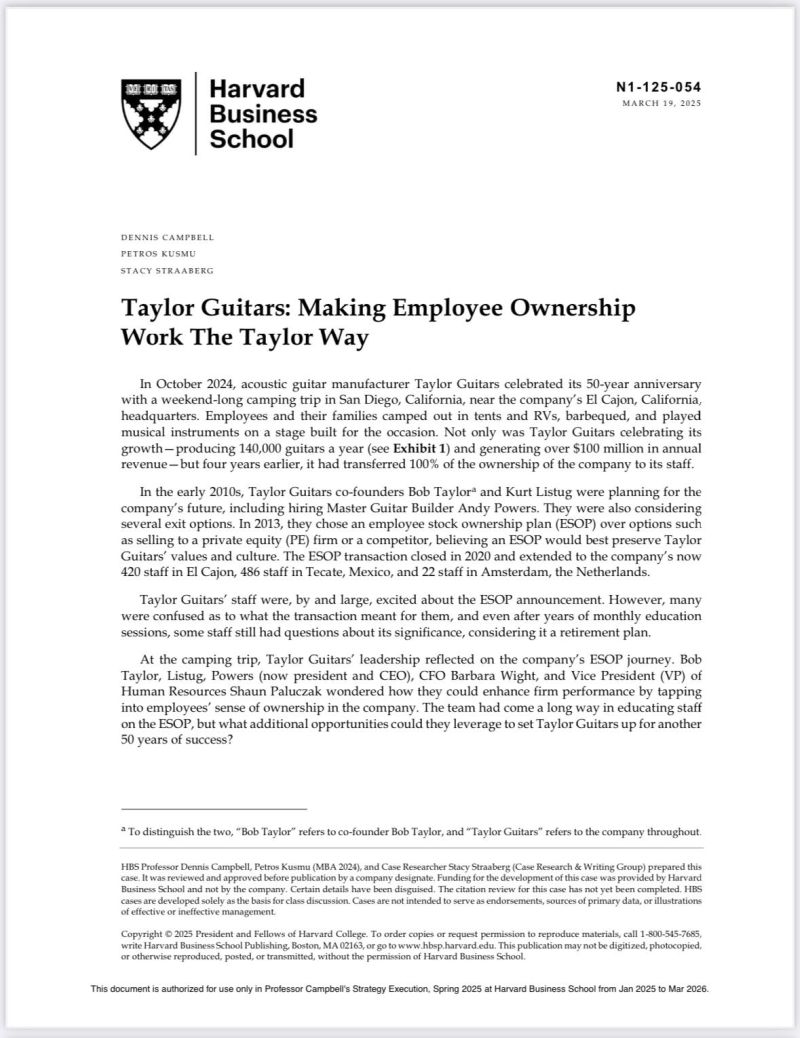
In 2013, guitar manufacturer Taylor Guitars’ co-founders Bob Taylor and Kurt Listug were considering several exit options including selling to a competitor or to a private equity firm.
The co-founders decided, instead, to embark on a seven-year process to transfer 100% of the ownership of the company from themselves and third owner partner Andy Powers to Taylor Guitars employees.
The co-founders felt an employee stock ownership plan (ESOP) would best preserve the company’s values and distinct culture and in 2021, the transaction was financed by Canadian pension fund Healthcare of Ontario Pension Plan (HOOPP), Canadian non-profit Social Capital Partners (SCP) and the owners.
In 2024, the co-founders, Powers (now president and CEO), CFO Barbara Wight, and Vice President of Human Resources Shaun Paluczak took time to reflect on the ESOP. Many employees were still unclear about what the ESOP meant for them, with some likening it to a retirement plan. The challenge for the leadership team was how to activate employees’ sense of ownership in the company to enhance Taylor Guitars’ performance.
Now, their employee-ownership transition is the subject of a 2025 Harvard Business School case study.
Share with a friend
Related reading

Social Capital Partners’ 2026 Federal Pre-Budget Submission
Canada must mobilize all the tools at our disposal right now to build a strong, sovereign, resilient economy.
Built to Reach: How institutional accountability shapes the reach of financial systems
Canada needs a greater diversity of accountability in financing institutions to reach all our viable enterprises.

Why Ownership Matters in the Climate Fight: An Interview with SCP Chair Jon Shell | Future of Good
SCP Chair Jon Shell discusses why ownership matters in the climate fight.