

Between 2019 and 2024, only 11.5% of all outstanding business loans in Canada went to small and medium-sized enterprises. Across the OECD, the average was 44%. And while SME lending has been growing in most peer economies, between 2016 and 2022, the share of Canadian lending going to SMEs actually shrank.
A new report from Social Capital Partners, Built to Exclude: Why Canada’s enterprises need a different kind of financing, argues that this is a visible signature of a financing system built around one institutional model. Six chartered banks hold more than 93% of Canadian banking assets and provide nearly 80% of SME lending outside Quebec.
Canada’s banking system is strong and stable. The big banks are good at what they do! The problem, when it comes to SME financing, is that what they can do is limited by how they’re structured.

What the system doesn’t finance
Liquidity rules, capital regulation and shareholder expectations shape every lending decision. The result is a system that struggles to provide whole categories of credit Canadian enterprises need: small loans, patient capital for productivity-improving investments, flexible terms for seasonal or project-based revenue, lending against intangibles like software and IP, mission-aligned capital for non-profits and community infrastructure, transition financing for owners exiting to employees or co-ops rather than private equity and relationship-based underwriting for borrowers whose viability doesn’t show up in standardized documentation.
The gap isn’t between viable enterprises and unviable ones. It’s between the kinds of lending that fit the dominant institutional model and the kinds that don’t. There’s a difference between an enterprise that’s inherently risky and one that simply doesn’t fit the operational model of a big, publicly traded, deposit-funded bank.
Looking outside the banks
Other countries have figured out how to overcome the structural limitations of big-bank financing by looking outside the banks.
Germany’s network of public savings banks, called the Sparkassen, serves community enterprises across the country. France’s Bpifrance is a large public bank with a statutory mandate for patient, long-term domestic financing aligned with industrial policy priorities. The U.S. and U.K. sustain robust ecosystems of community development financial institutions that channel capital to underserved communities and enterprises. Credit unions in countries like the U.S. and the U.K. have benefited from regulatory frameworks scaled to their size and risk.
Canada has made some attempts to cater to the specific needs of SMEs through the Business Development Bank of Canada, the Social Finance Fund and Community Futures, but these programs lack the scale and permanence to fundamentally change the landscape. They’re patches on a system that needs structural change.
Canada ranks second-worst in the G7 as a place to be an entrepreneur, with 55 per cent of small-business owners saying they would not recommend starting a business here right now. We would argue that this is not a reflection of the limits of our entrepreneurs, but the limits of our lenders.
The productivity, resilience, inclusive growth and economic sovereignty objectives Canada is trying to achieve are not independent of its financing system. They are shaped by it. Canada can continue treating its financing monoculture as inevitable, or it can follow the lead of peer jurisdictions and intentionally build the institutional diversity required for a different outcome.
If we want a stronger economy that works for workers, communities and small businesses, we need a financial system diverse enough to serve them.
Share with a friend
Related reading
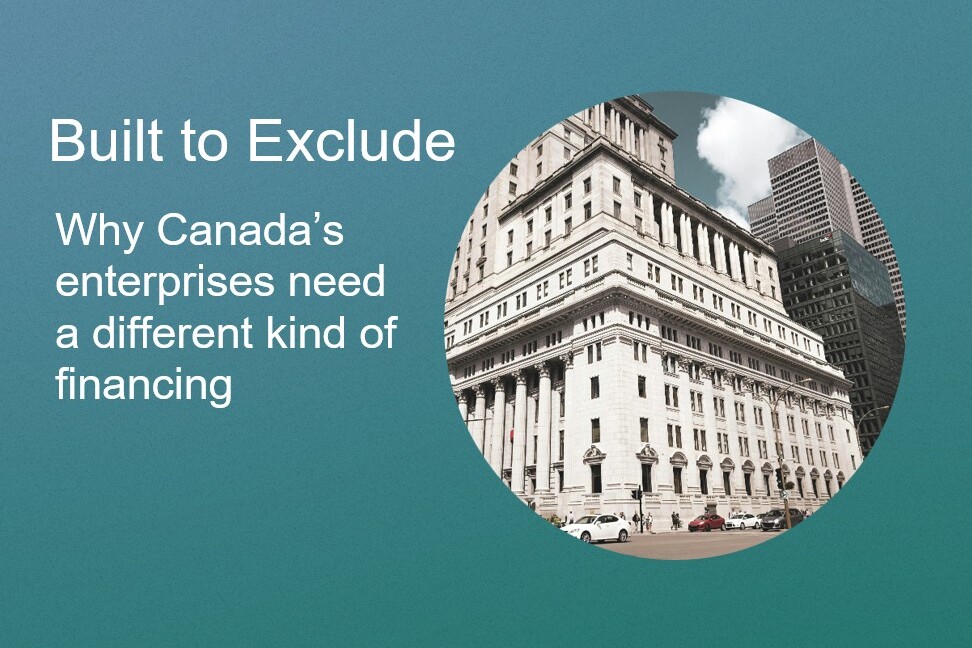
Built to Exclude: Why Canada’s enterprises need a different kind of financing | Report
Canada's enterprise financing system is dominated by big banks that control 93% of banking assets and nearly 80% of SME lending. While stable and respected, they have structural constraints—minimum deal sizes, rigid credit models, collateral requirements—that systematically stop them from lending to a range of viable businesses. The SMEs left behind include businesses looking for small loans, seasonal enterprises, non-profits, cooperatives and rural firms. If we continue to undercapitalize SMEs trying to get off the ground or grow, this will have cascading economic and social consequences. Canada needs alternative financing institutions that operate alongside commercial banking as permanent, scaled infrastructure.

👏 Letting the big W sink in
In the Spring Economic Update, the federal government moved to make the legislative structure and tax incentive for Employee Ownership Trusts (EOTs) permanent. This is amazing news! At Social Capital Partners, we are grateful that the government has made these changes. Thanks to Prime Minister Mark Carney, François-Philippe Champagne and Ryan Turnbull for understanding the importance of employee ownership. This and more all in one funny-but-factual biweekly read.

Are Canadian pension funds stepping up for Canada at this moment of threat? All signs point to maybe
Large Canadian pension plan OMERS announced earlier this week that it will attempt to increase its investments in Canada by $10B over the next five years. This is a good sign, says SCP CEO Matthew Mendelsohn, but announcements and good intentions will not be enough. The incentive structure for fund managers, and the allocation of resources across asset classes and geographies, will need to change if pension funds are able to deliver on what their contributors and beneficiaries expect of them.