

🇨🇦 💪Strengthening the ownership agenda
What's next for the ownership agenda, how to get more capital to SMEs and why ownership matters.
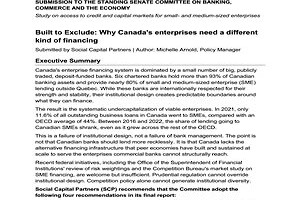
BANC committee submission on SME financing
Canada can continue treating its financing monoculture as inevitable, or it can follow the lead of peer jurisdictions and intentionally build the institutional diversity required for a different outcome. The status quo produces predictable, cumulative exclusions that compound over time into lower productivity, narrower entrepreneurship, weaker community resilience and entrenched inequity.

New research on the Big Banks and the businesses left behind
The productivity, resilience, inclusive growth and economic sovereignty objectives Canada is trying to achieve are not independent of its financing system. Canada ranks second-worst in the G7 as a place to be an entrepreneur, with 55 per cent of small-business owners saying they would not recommend starting a business here right now.
Built to Exclude: Why Canada’s enterprises need a different kind of financing
Canada's enterprise financing system is dominated by big banks that control 93% of banking assets and nearly 80% of SME lending. While stable and respected, they have structural constraints—minimum deal sizes, rigid credit models, collateral requirements—that systematically stop them from lending to a range of viable businesses.

Why Canada should back employee ownership trusts for the long term | TheFutureEconomy.ca
Established in 2024, Employee Ownership Trusts (EOTs) allow business owners to sell their companies to a trust held on behalf of employees, keeping firms in Canadian hands, building worker wealth and strengthening local communities. Jon Shell makes the case for EOTs in TheFutureEconomy.ca. With a temporary capital gains tax exemption set to expire in 2026, he and other advocates are urging the federal government to make the incentive permanent before momentum stalls.

Ontario wakes up to the succession tsunami
In November, 2025, the Ontario provincial government finally stepped into the looming “succession tsunami,” launching a modest $1.9M Business Succession Planning Hub to help micro-business owners plan exits through local Small Business Enterprise Centres. Notably, the hub spotlights employee ownership and the new Employee Ownership Trust, signaling a shift toward mainstream adoption. But, as Dan Skilleter writes, Ontario’s approach focuses narrowly on retiring owners, ignoring how different buyers shape risks and benefits to workers, communities and Canada's broader economic sovereignty. This is a promising start that could and should grow into a broader succession-planning policy that protects Ontario’s long-term resilience.
Smith School of Business launches new Employee Ownership Research Initiative
Smith School of Business at Queen's University is launching Canada's first-ever research initiative focused on deepening Canada’s knowledge and understanding of a powerful succession model that can enhance outcomes for owners, employees and communities: employee ownership.

Pipelines and algorithms aren’t going to save us | The Hill Times
Smart investments in natural resources and AI alone will not get us through this moment of geopolitical rupture. As Matthew Mendelsohn writes in an op-ed for The Hill Times, SMEs contribute just over half of Canada’s GDP and employ 64 per cent of our people. We have to make more low-cost capital available to the smaller businesses, locally owned enterprises, not-for-profits and social enterprises who crucially employ and reinvest locally, act as important local economic infrastructure and provide services that are crucial for well-being. They are automatic stabilizers in the face of tariff threats outside our control.

The tariff war means a new normal for Hamilton businesses | Hamilton City Magazine
The wrecking ball that Donald Trump has taken to international trade has wounded relations between Hamilton businesses and their American suppliers and customers, reports Eugene Ellman in Hamilton City Magazine. Now, they’re looking east and west to replace traditional links to the south and pushing back. When Trump started pontificating about how Canada should become the 51st state and claiming the United States was subsidizing its northern neighbour, SCP Founder Bill Young and the team responded with Always Canada. Never 51 - part economic populism mixed with methodical policy-making, the series is devoted to the issues of wealth inequality and Canadian sovereignty.

As the federal government sets out to “build, baby, build,” do we want to own or be owned?
As our new government pursues growth and a nation-building agenda, we should remember this lesson from history: too often, we build and invest, only to sell off our assets and resources to the highest foreign bidder, leaving us economically vulnerable. In this moment of extreme peril, SCP CEO Matthew Mendelsohn asks how we should “build, baby, build” in a way that doesn’t merely accelerate the trends towards consolidation of wealth and deeper economic dependence. Canada has everything we need to emerge stronger from this period of geopolitical disruption if we put economic sovereignty and broad access to wealth-building at the heart of our agenda.