

By | Part of our Special Series: Always Canada. Never 51 | Reprinted with permission from The Hill Times
Following Donald Trump’s first threats to annex Canada, there was a country-wide energy to forge a new and more independent path, with political rhetoric to match. But with Trump’s “51st state” bluster diminishing, Mark Carney’s drama-free visit to the White House and a stay-the-course cabinet, Canadian business leaders seem eager to settle for the best “new-new-NAFTA” we can get.
This tendency toward the status quo is exactly what fuels Canada’s self-loathing: we’re not entrepreneurial enough, don’t take enough risks, don’t invest in our potential. Instead of charting ambitious, but uncertain, territory, we defer to the corporate lobbyist on our shoulder whispering “be practical.”
Playing it safe is both the wrong short-term tactic and the wrong long-term strategy. Sure, Canada could probably get a new deal if we don’t anger the president but it would undoubtedly be a downgrade – just as CUSMA is worse than NAFTA – because, as JD Vance likes to say, we don’t have the cards. We’d remain an underperforming “branch-plant economy,” selling our innovations and resources south for pennies on the dollar. And it would leave us exposed to the same risks of military and economic dependency currently on stark display.
Instead, Canada should lead the world’s middle powers in a collective and overdue weaning from American primacy by establishing a grand new security and economic alliance.
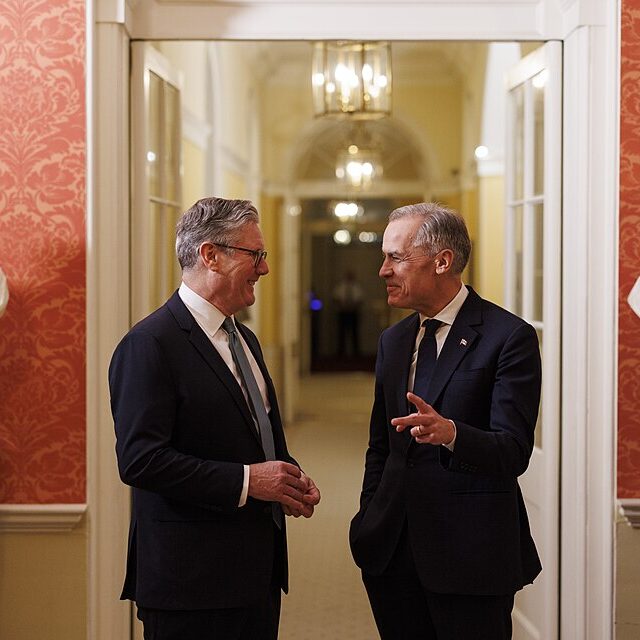
Ten countries – Canada, Australia, France, Germany, Italy, the U.K., Spain, Japan, South Korea and the Netherlands, or the “Core 10” – would amount to about the same GDP as the U.S., with significant natural resources and about six hundred million wealthy residents with massive buying power. From Robert Reich to The Economist, versions of this idea have been proposed, all with the objective of creating leverage against American economic aggression.
While each potential grouping of countries would have its complexities, even one formal meeting to discuss a new alliance would be enough to demonstrate that a break from U.S. dominance is possible. Announcing new multilateral partnerships in areas of American interest such as military procurement, pharmaceutical development, cloud infrastructure or resource refinement would solidify the group’s potential.
It is clear that President Trump fears this possibility.
Prime Minister Carney’s visit to France and the UK in March prompted Trump to threaten “large scale tariffs, far greater than currently planned” if the European Union were to work with Canada to “do economic harm to the USA.” His reaction proves the idea’s merit – America’s global trade war can only succeed against a divided opposition.
A new alliance is also the right long-term strategy. While the U.S.-led western countries had a long and successful run after World War II, we are all now facing similar crises, including decreasing housing affordability, increasing inequality and repeated failures to address climate change. As a result, belief in democracy, capitalism and global institutions are in steady, long-term decline, along with global comfort with American leadership.
Part of the issue is that, in many ways, America has become an outlier among its allies. On issues like health care, taxation, social security and climate, and on critical social metrics like inequality, life expectancy and gun violence, the middle powers of the Core 10 are both highly aligned and diverging further and further from the U.S. Common ground to solve our collective challenges will remain elusive with America at the table.
A middle power alliance, however, built on security and economic commitments patterned after NATO, would constitute an ambitious, creative and credible third power centre alongside the U.S. and China. Unshackled from American dominance, these countries so aligned in values and approaches could develop innovative new solutions to our common crises. Rather than trying to salvage a collapsing world order in which so many have lost faith, Canada and its Core 10 allies could build the next great era of democratic progress.
The U.S. will always be Canada’s largest trading partner and so a new deal is necessary. But we should resist the temptation to choose short-term comfort and certainty. By finally stepping into a more entrepreneurial and ambitious leadership role, not only can we improve our own hand in trade negotiations with America, but spark energy and enthusiasm for a new and better global superpower.
Share with a friend
Related reading

New research on the Big Banks and the businesses left behind
The productivity, resilience, inclusive growth and economic sovereignty objectives Canada is trying to achieve are not independent of its financing system. Canada ranks second-worst in the G7 as a place to be an entrepreneur, with 55 per cent of small-business owners saying they would not recommend starting a business here right now. A new SCP report by Michelle Arnold argues that this is not a reflection of the limits of our entrepreneurs, but the limits of our lenders - when it comes to SME financing, what the Big Banks can do is limited by how they're structured. If we want a stronger economy that works for workers, communities and small businesses, we need a financial system diverse enough to serve them.
Built to Exclude: Why Canada’s enterprises need a different kind of financing | Report
Canada's enterprise financing system is dominated by big banks that control 93% of banking assets and nearly 80% of SME lending. While stable and respected, they have structural constraints—minimum deal sizes, rigid credit models, collateral requirements—that systematically stop them from lending to a range of viable businesses. The SMEs left behind include businesses looking for small loans, seasonal enterprises, non-profits, cooperatives and rural firms. If we continue to undercapitalize SMEs trying to get off the ground or grow, this will have cascading economic and social consequences. Canada needs alternative financing institutions that operate alongside commercial banking as permanent, scaled infrastructure.

👏 Letting the big W sink in
In the Spring Economic Update, the federal government moved to make the legislative structure and tax incentive for Employee Ownership Trusts (EOTs) permanent. This is amazing news! At Social Capital Partners, we are grateful that the government has made these changes. Thanks to Prime Minister Mark Carney, François-Philippe Champagne and Ryan Turnbull for understanding the importance of employee ownership. This and more all in one funny-but-factual biweekly read.