
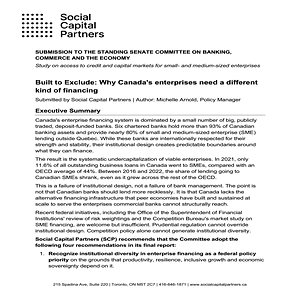
Executive Summary
Canada’s enterprise financing system is dominated by a small number of big, publicly traded, deposit-funded banks. Six chartered banks hold more than 93% of Canadian banking assets and provide nearly 80% of small and medium-sized enterprise (SME) lending outside Quebec. While these banks are internationally respected for their strength and stability, their institutional design creates predictable boundaries around what they can finance.
The result is the systematic undercapitalization of viable enterprises. In 2021, only 11.6% of all outstanding business loans in Canada went to SMEs, compared with an OECD average of 44%. Between 2016 and 2022, the share of lending going to Canadian SMEs shrank, even as it grew across the rest of the OECD.
This is a failure of institutional design, not a failure of bank management. The point is not that Canadian banks should lend more recklessly. It is that Canada lacks the alternative financing infrastructure that peer economies have built and sustained at scale to serve the enterprises commercial banks cannot structurally reach.
Recent federal initiatives, including the Office of the Superintendent of Financial Institutions’ review of risk weightings and the Competition Bureau’s market study on SME financing, are welcome but insufficient. Prudential regulation cannot override institutional design. Competition policy alone cannot generate institutional diversity.
Social Capital Partners (SCP) recommends that the Committee adopt the following four recommendations in its final report:
- Recognize institutional diversity in enterprise financing as a federal policy priority on the grounds that productivity, resilience, inclusive growth and economic sovereignty depend on it.
- Commission a federal review of Canada’s alternative financing infrastructure — credit unions, public financial institutions, Community Development Financial Institutions (CDFI)-equivalent intermediaries (e.g. Community Futures network, and mission-driven lenders) to identify scale gaps and the policy levers required to close them.
- Establish a formal Canadian CDFI designation and capitalization framework, drawing on the U.S. and U.K. models.
- Examine the regulatory architecture for non-bank and smaller deposit-taking lenders to ensure that prudential rules calibrated for systemically important banks do not suppress the viability of credit unions and other community-scale institutions.
Introduction
Social Capital Partners welcomes the opportunity to contribute to the Committee’s study on access to credit and capital markets for small- and medium-sized enterprises (SMEs) as the basis for growth and improved productivity in the Canadian economy. SCP is a Canadian non-profit organization and impact investor that leads public policy research and advocates for ideas that broaden access to wealth, ownership and economic security.
This brief draws on SCP’s recent paper, Built to Exclude: Why Canada’s Enterprises Need a Different Kind of Financing, which argues that big-bank dominance of enterprise financing in Canada is an institutional design failure that has led to the undercapitalization of viable enterprises across the economy.
A well-functioning financing system matches capital to productive uses. Because viable enterprises vary widely in their risk profiles, time horizons and return expectations, serving them requires lenders with a corresponding range of optimization strategies. Canada’s system, dominated by one institutional model, cannot do this.
This is not a critique of Canadian banks. It is a critique of an enterprise financing landscape that asks them to play a role they are not structurally suited for. Other economies have taken a different path, building and sustaining alternative financing infrastructure that complements commercial banking at meaningful scale. Canada has some of these pieces but not at the scale or permanence required to alter the underlying structure of the system.
Structural constraints of big-bank lending
Canada’s six largest chartered banks (BMO, Scotiabank, CIBC, National Bank of Canada, RBC and TD) account for more than 93% of Canadian banking assets and provide nearly 70% of all debt financing to SMEs nationally. Excluding Quebec, where credit unions have a stronger foothold, they provide nearly 80% of SME lending.
These banks operate within a tightly defined lending envelope shaped by their institutional design. Liquidity requirements and capital regulation, both essential safeguards for depositors and financial stability, constrain the types of risks banks can take. The asymmetric payoff structure of debt generates a structural risk aversion. Standardized underwriting models require verifiable, quantitative financial data. Quarterly reporting cycles discourage patient relationship-building. Return-on-equity targets create a floor below which lending opportunities are rejected regardless of credit quality.
These features are not arbitrary choices or failures of management. They flow directly from the institutional design of big, publicly traded, deposit-funded banks. The relevant policy question is not whether to fight these constraints, but what institutional infrastructure exists to serve the enterprises that fall outside them.
How institutional dominance translates to systemic exclusion
In a diverse financing ecosystem, different institutional types serve different enterprise profiles. When one model dominates, its blind spots become the system’s blind spots. The result is a consistent set of eligibility criteria that exclude viable enterprises:
- Minimum deal size. Loans under $250,000 are considered unprofitable due to fixed transaction costs. Authorizations of loans under $1M have been declining in Canada, while loans over $5M have been increasing.
- Standardized terms. Rigid credit models cannot accommodate flexible repayment schedules or the atypical terms required by firms with seasonal revenue, uneven cash flow, or long payback horizons.
- Conventional borrower profile. Borrowers with thin credit files or limited business history struggle to access financing, even when alternative risk indicators suggest viability.
- Standard organizational structure. Non-profits, cooperatives, charities and Indigenous-owned enterprises frequently fall outside banks’ explicit criteria or perceived eligibility pathways.
- Tangible collateral. 63.4% of Canadian SMEs are required to provide collateral to access debt financing, compared to an OECD average of 51.5%.This disadvantages asset-light and service-based firms.
- Familiar geography and sectors. 70% of urban firms access financing via domestic chartered banks, versus only 45% of rural firms.
- Commercial return threshold. Businesses pursuing community, environmental or low-margin missions struggle to access commercial credit even when financially sound.
There is a difference between an enterprise that is inherently risky and one that simply does not fit within the operational model of big, publicly traded, deposit-funded banks. Canada’s exclusionary financing environment reflects the limits of our dominant lenders, not the limits of our enterprises.
The enterprises left behind
Despite employing 64% of Canada’s workforce and accounting for 48% of GDP, Canadian SMEs capture only a small fraction of commercial credit. Even as total commercial lending in Canada expanded by 165% between 2011 and 2024, only 11.3% of outstanding commercial lending in 2021 was directed to SMEs, significantly below the OECD median of 44%. While lending to small businesses is increasing in other developed economies, Canada is moving in the opposite direction. Between 2016 and 2022, the share of lending going to Canadian SMEs shrank, even as it grew across the rest of the OECD.
The exclusion is not evenly distributed. The most consistently underserved enterprise categories include:
- Non-profit and purpose-led businesses. While 40% of all SMEs report financing as a barrier, that figure rises to over 75% among non-profit enterprises.
- Community infrastructure. Despite insolvency rates for affordable housing of just 0.35%— well below the all-industry average of 1.3% — non-profit housing providers have resorted to issuing community bonds to bypass traditional banks.
- Marginalized business owners. In 2023, majority Black-owned businesses were 26% less likely to have loan requests fully approved than the average SME. Businesses owned by persons with disabilities were 31% less likely to be approved. New immigrants are twice as likely to be “credit invisible” as Canadian-born families.
- Business modernization. Banks’ conservative credit models favour lending for safe, short-term gains (like real estate purchases or proven expansion projects) over financing for productivity improvements that may have longer payback. The consequences of this underinvestment are visible at the national level. Canadian businesses invested only 41 cents in machinery and equipment for every dollar invested by their U.S. counterparts in 2024.
- Business transition. Three quarters of Canadian small business owners plan to exit their business within the next decade, yet banks are reluctant to lend for transitions to employee ownership trusts, cooperatives, or community ownership.
- The intangible economy. Firms whose value resides in software, patents, contracts or expertise struggle to qualify under Canada’s collateral-driven lending system. By 2024, the average Canadian worker benefited from only 32 cents of new investment in IP products for every dollar invested for the average U.S. worker.
Across these categories, the pattern is consistent. Enterprises that require patient capital, relationship-based underwriting, flexible terms or mission-aligned financing struggle to access bank credit, regardless of viability. These businesses warrant financing. Big banks are not structured to provide it.
The compounding cost of exclusion
The systemic undercapitalization documented above generates cascading economic and social consequences. While isolating the precise contribution of financing constraints from other factors is methodologically difficult, the weight of evidence is clear:
Lower productivity and competitiveness. Insufficient capital access has been shown to hinder SME innovation. OECD research confirms that growth-oriented SMEs in Canada lag their international peers in scaling up.
Declining entrepreneurship and community resilience. After Italy, Canada ranks as the second-worst place in the G7 to be an entrepreneur. Recent research from the CFIB shows that access to financing is the second most commonly cited barrier to entrepreneurship. Communities with higher proportions of SMEs have stronger per capita growth, faster employment growth, lower poverty rates and improved public health outcomes.
Entrenched inequity and reduced economic mobility. Seventy percent of SME owners rely on personal assets to finance their businesses, meaning that for those without family wealth, business ownership is effectively out of reach. Only 16.8% of Canadian SMEs are women-owned, compared with 39% in the United States. Only 1.3% of Black adults are entrepreneurs, compared to 2.3% for all Canadian adults. Indigenous peoples represented 5% of Canada’s population in 2022 but accounted for only 1.7% of majority-owned private businesses. As access to ownership narrows, so do the pathways to intergenerational wealth-building.
Recommendations
Recent federal initiatives signal recognition that Canada’s enterprise financing system is leaving viable businesses behind. OSFI is reassessing risk weightings to encourage more bank lending. The Competition Bureau has launched a market study on SME financing. These are welcome steps. They are also insufficient. Prudential regulation, while important, cannot override institutional design. Competition policy alone cannot generate institutional diversity.
Peer economies have actively cultivated alternative financing infrastructure. Germany’s Sparkassen network of public savings banks provides local enterprise financing outside the commercial banking system. France’s Bpifrance is a large public bank with a statutory mandate for patient, long-term investment. The U.S. and U.K. have built robust ecosystems of community development financial institutions, capitalized through balance sheet support, loan guarantees, capacity building and tax credits. The U.S. and U.K., have built regulatory frameworks scaled to the size and risk of credit unions.
Canada has some important infrastructure, but it lags other jurisdictions. The Business Development Bank does important work, but its $46.9 billion balance sheet is a fraction of what the Big Six hold – and it excludes non-profits. We have community financing entities, Indigenous financial institutions and a growing impact lending sector, but no formal designation, no unified federal framework, and nothing close to the scale of what comparable countries have built. We have a number of strong credit unions, but provincial regulatory fragmentation and federal regulation requirements pose challenges to their ability to grow and scale.
SCP recommends that the Committee adopt the following four recommendations in its final report:
Recommendation 1: Recognize institutional diversity as a federal policy priority
The Government of Canada should adopt institutional diversity in enterprise financing as an explicit objective of federal economic and financial policy. Productivity, resilience, inclusive growth and economic sovereignty are not independent of the financing system; they are shaped by it. A financing landscape dominated by one institutional model cannot deliver on these objectives, regardless of how well that model performs within its own envelope. Recognizing diversity as a policy priority would establish a frame against which subsequent regulatory, fiscal and program decisions could be evaluated.
Recommendation 2: Commission a federal review of alternative financing infrastructure
The Government of Canada should, through the Department of Finance, in coordination with Innovation, Science and Economic Development Canada, undertake a formal review of Canada’s alternative financing infrastructure. The review should assess current scale, identify gaps, and make recommendations around policy opportunities. Pillars in scope should include:
- Credit unions, including the implications of provincial regulatory fragmentation and the distinct cooperative finance ecosystem in Quebec;
- Public financial institutions, including the Business Development Bank of Canada, Farm Credit Canada, Export Development Canada and provincial development corporations;
- Community Development Financial Institution-equivalent intermediaries currently operating without a unified federal designation;
- The Community Futures network and other place-based lenders;
- Mission-driven and cooperative lenders serving non-profits, social enterprises, and Indigenous communities.
Recommendation 3: Establish a formal Canadian CDFI designation and capitalization framework
That the Government of Canada establish a formal designation framework for Community Development Financial Institutions in Canada, with associated capitalization, tax treatment and reporting standards. The framework should draw on established models in the U.S. and the UK. A formal designation would create a defined institutional category that can be systematically supported, capitalized and held accountable.
Recommendation 4: Examine the regulatory architecture for non-bank and smaller deposit-taking lenders
That the Office of the Superintendent of Financial Institutions, in coordination with provincial regulators where appropriate, examine whether prudential rules calibrated for systemically important banks are appropriately adapted for credit unions, community banks and other smaller deposit-taking institutions. International evidence indicates that one-size-fits-all prudential treatment can suppress institutional diversity by imposing compliance costs disproportionate to the risk these institutions actually pose to the financial system.
Conclusion
Canada can continue treating its financing monoculture as inevitable, or it can follow the lead of peer jurisdictions and intentionally build the institutional diversity required for a different outcome. The status quo produces predictable, cumulative exclusions that compound over time into lower productivity, narrower entrepreneurship, weaker community resilience and entrenched inequity. The recommendations above are not the full answer, but they are our suggestions on some ways to improve the architecture of the financing system to serve more enterprises. The current architecture should not be presumed to be immutable. SCP would welcome the opportunity to discuss this submission with the Committee in more detail and looks forward to the publication of the Committee’s findings.
Share with a friend
Related reading

Why Ownership Matters in the Climate Fight: An Interview with SCP Chair Jon Shell | Future of Good
SCP Chair Jon Shell discusses why ownership matters in the climate fight.

Cross Check: What are we fighting for? (Ep. 8) | Stephen Marche, Jon Shell and Vass Bednar
Stephen Marche, Jon Shell and Vass Bednar discuss the season two finale of The Gloves Off Podcast.

Cross Check: How Canada Beats Tech Influence (Ep. 7) | Stephen Marche, Jon Shell and Vass Bednar
Stephen Marche, Jon Shell and Vass Bednar discuss the second half of a two-parter on tech sovereignty.