
How can we create a more democratic and inclusive economy?
At the 2026 DemocracyXChange Summit, the Atkinson Foundation and Social Capital Partners put this question to 40 leaders who play different roles in shaping local economies. Their responses were informed by different strategies and experiences but united by a shared belief that the dominant extractive and financialized economic model is failing an increasing number of people, with the impacts more acutely felt by those already struggling to afford housing, care, food, and secure work, while a much smaller number race ahead.
This day-long roundtable was an open-ended exchange of first-hand stories and promising ideas about how Canada can do better. We discussed how our economy and democracy can be strengthened in order to retain more wealth in local communities. At this moment of historic economic and geopolitical change, we concluded that we have agency to make choices to build a better economy.
There is not one solution or one unified agenda that emerged from our deliberations but organizing and implementation are happening in many different and intersecting ways across the country. We left with an even greater sense of urgency and commitment to using pragmatic, democratic practices to create the local economies we want, and to support one another in this work.
Economic systems that work for a shrinking number of people are not sustainable. But change is possible.
What does an inclusive, democratic economy look like?
Democracy cannot be disconnected from the economic model that shapes our lives. Democracy is more than an abstract set of rules and procedures. To be meaningful, people must have a say over the economic forces that shape whether they can afford a decent life. A democratic and inclusive local economy is one in which everyone, and especially those with the least, has the freedom and power to build a good life for themselves, however they choose to define it. In practice, it can look like this:
• Ownership is broader and more rooted in place. This would mean more assets and enterprises owned by workers and communities. Examples would include co-operatives, employee-owned firms, locally owned businesses, non-profit housing, and community land trusts.
• The workplace is more democratic. This would mean rebalancing power at work. Examples would include stronger labour standards, collective bargaining, fair wages, safe conditions, and worker participation in decision-making.
• Public dollars serve public goals. This would mean directing infrastructure spending and economic development toward local benefit. Examples would include social procurement, community benefits agreements, and inclusive economic development strategies.
• Capital is accountable to place. This would mean keeping investment rooted locally and accountable to the people most affected by economic insecurity and disinvestment. Examples would include community finance funds, local investment vehicles, mission-driven lending, credit unions, and community development finance institutions.
• Land and housing are recognized as social, economic, and public health
foundations. This would mean using land and housing to meet community needs rather than maximize speculative return. Examples would include community land trusts, non-market housing, affordable commercial space, and permanent community stewardship models.
• Communities have real say. This would mean giving residents more say in the development and stewardship of community assets, without deploying this principle in a way that entrenches privilege and excludes others. Examples would include participatory planning, community governance models, tenant organizing, neighbourhood development tables, and community benefits processes.
The conversation lifted up concrete examples of this work in action: from Toronto communities using major infrastructure projects to generate community benefits, to Parkdale neighbourhood residents collaborating on a people’s economy project and placing land under community stewardship; from funeral co-operatives in Quebec preserving affordability and countering corporate consolidation, to workers gaining ownership stakes through employee ownership trusts; from Nova Scotia setting up retail investment vehicles to invest in local businesses, to under-used religious property being repurposed for community benefit rather than condo developments; from institutions directing purchasing power toward social value, to communities mobilizing their own savings to invest locally through community bonds and other forms of democratic finance.
These efforts rarely represent the easiest path, nor the most immediately profitable. They focus on delivering returns across multiple dimensions and for the benefit of diverse stakeholders and constituencies. They often emerge where the status quo has most obviously failed, and where the people and systems being transformed by crisis are left with little choice but to collaborate in building something new.
What are we up against?
Who gets to stay in a neighbourhood as land values rise? Who benefits when public and private dollars are spent in a community? Who decides where capital is invested? Who has a say at work? Who stewards and governs the assets communities depend on? At a moment when extreme inequality is becoming more entrenched and ownership of assets is becoming more concentrated, we see that:
• Those who earn the least often have the least say over their wages and working conditions.
• Care is treated as a market to be consolidated rather than essential social infrastructure.
• Neighbourhood land is seen first as an asset class, rather than as a public good to be used for homes and community benefit.
• Households take on debt to meet basic needs, while shareholder returns increase and profits generated locally pool elsewhere.
• Neighbourhood businesses disappear or change hands without workers or communities having a fair chance to take ownership.
Together, these local problems are manifestations of unaccountable and unequal economic power, deployed by those seeking to maximize their wealth with little regard for the impact on local communities and the people who live in them. At the moment, we are also sometimes up against the mindset that all of this is inevitable, making some people complacent or despondent in the face of overwhelming systemic problems.
But we know that how the economy works is a product of human choices and design. Just as the current model stems from public policy choices both big and small, these can be undone and the economy can be re-made to work for more people and communities.
Where can our combined efforts make the biggest difference?
Everyone who participated in the roundtable is finding ways to deploy their leverage and expertise to change the economy so that benefits and wealth are more widely shared. While the work itself is diverse and overlapping, the following highlights five recurring threads from the conversation about where our efforts are needed most: narrative change, redirecting capital, public policy innovation, strengthening intermediaries and civil society networks, and building people power.
Building possibilities with new narratives
In the absence of compelling and relatable narratives about the economy and democracy, public frustration about economic inequality can be easily misdirected toward migrants, neighbours, public institutions, taxes, and other convenient scapegoats. At the same time, conversations about the economy and democracy are often overly technical and disconnected from everyday experience. What we need instead are plain-language ways to help people connect the pressures they are feeling in their lives to the broader systems shaping them, while making clear that these systems are neither inevitable nor fixed.
Part of this work involves making economic relationships more visible. Shorefast’s “economic nutrition label”, for example, shows consumers where their money goes when they make a purchase, including how much supports wages and local suppliers, and what portion stays in the surrounding region or leaks elsewhere.
But narrative change is not only about visibility. It also requires challenging assumptions about who the economy is for and what it should reward. Indigenous concepts raised during the day, including Land Back and responsibilities to future generations, point to longstanding practices of stewardship and multi-generational collective responsibility that challenge extractive approaches to ownership and wealth. Similarly, Toronto’s community wealth building work broadens the agenda to focus on the harms produced by inequality and identifies ways to shape the underlying economic systems that determine how wealth and opportunity are distributed in the first place.
Ultimately, this narrative work must be truthful and empowering, helping people understand how the choices governments and institutions make shape everyday life, and how different choices can produce different outcomes. They should also offer concrete examples of collective action and democratic practice that expand people’s sense of agency and possibility to privilege the public and community interest rather than private benefit.
Rewiring the flow of capital
Value is generated by workers and in communities but mostly captured elsewhere in our economy. Reshaping the flow of capital so that it is rooted in communities and accountable to the people affected by its deployment can help change that fact. The key observation was that more and different kinds of people should have a say in how capital is invested, with different accountability structures, and seeking different kinds of returns. This opens the door for investment decisions to pursue a broader range of outcomes alongside risk adjusted
market returns, including decent work, long-term community wellbeing, democratic participation, intergenerational stewardship, and environmental sustainability. This will require some changes in the assumptions financial actors use to determine who is investable and what kinds of projects are worthy of investment.
Community land trusts, co-operatives, social enterprises, and non-profit housing providers often compete to secure even modest financing, as traditional lenders view them as too small or too risky. The tools of the social economy, such as community bonds, credit unions, community trusts, microfinance, and mission-driven lending were cited as practical tools to keep wealth circulating locally and expand access to capital for communities historically excluded from mainstream finance. In British Columbia, for example, the Vancity Affordable Community Housing Program has combined credit union capital with foundation-led funds to support early-stage affordable housing development, taking on risk that traditional lenders will not. 10C Shared Space in Guelph, Ontario offers another example, using community bond financing to transform a historic building into a hub for community enterprise.
We know from doing this work that people are interested in finding opportunities to invest in their local economies, and are often willing to accept more modest returns in exchange for stronger social and community outcomes. Public opinion research conducted by Co-operatives and Mutuals Canada and Abacus Data, suggests that a majority of Canadians are interested in finding economic choices that better align with their values.
At the same time, even as we fight to build the social economy, far larger flows of capital continue to reinforce the dominant economy through mainstream bank, finance, and institutional investors. But this too is our money. Pension funds, for example, pool workers’ savings and can use their influence as major investors to set expectations around local economic benefit and decent work. In Quebec, la Caisse de dépôt et placement du Québec, which manages the pension savings of Quebec workers, has a dual mandate to generate returns while contributing to the province’s economic development. Tools such as Indigenous and community trusts, alongside shareholder advocacy, similarly offer ways to make that capital more accountable and influence how it is deployed across the investment cycle.
Innovating through public policy
The economy is structured by policy choices made by governments that constrain and incent different kinds of activities that produce different outcomes. Those with wealth have more power to influence the policies that shape markets and economic outcomes. If we want different outcomes, we need to propose good ideas and re-write those rules.
Public policy can set expectations and create incentives for how public dollars and private decisions contribute to inclusive economic outcomes. Scotland’s Community Wealth Building legislation requires ministers to publish a community wealth building statement, while local authorities must develop and implement local action plans. In Canada, hard-won measures in the Income Tax Act support the formation of employee ownership trusts and worker co-operatives by incentivizing qualifying business owners to exempt up to $10 million in capital gains when selling to their employees.
At the municipal level, the City of Toronto recently passed its Inclusive Economic Development Framework, which sets out a shared vision for the city’s economy, along with tools to get there, building on existing policies such as the Community Economic Development Fund, land use and planning policies, municipal Fair Wage Policy, community benefits, and AnchorTO social procurement work. The Framework embeds this work within the City’s 10-year Economic Development Strategy and expands how success is measured, adding indicators to the City’s economic dashboard that focus on the quality of economic growth, not just the quantum.
It is clear that policy and practice are mutually reinforcing. Each creates the conditions for the other to move further. Ground-level work is where people name problems and build solutions in real time; public policy acts as an enabler, removing obstacles and aligning incentives. In turn, new policy then opens space for good ideas to grow and more communities to exercise their democratic power to act and deliver positive outcomes on the ground.
Strengthening intermediaries and civil society networks
In order for this work to build momentum beyond individual projects, intermediaries play a valuable and sometimes under-recognized role. They are the ones holding the ecosystem together, mapping who is doing what, convening people across sectors and regions, representing shared interests, advocating on behalf of shared interests, and supporting the translation between policy and practice. Intermediaries play a role in giving small, community-rooted enterprises the advantages of scale without compromising the local base that makes them effective and accountable.
This work of building “connective tissue” within and across sectors and regions is critical. Quebec offers a particularly developed example of this ecosystem approach. There, organizations play a field-building role. At the provincial level, the Chantier de l’économie sociale plays a central coordinating role across regions and sectors, representing the social economy to government and helping shape policy.
In Quebec’s funeral industry, the co-operative movement helped bring prices from above the Canadian average to the lowest in North America with just roughly 20 per cent of the market share. The work there demonstrates that we do not have to change everything everywhere all at once. Even modest shifts, properly executed, can produce transformative impacts. Getting small growth in the number of co-ops, employee owned firms, union membership, non-market housing units, or publicly owned enterprises can shape markets towards more inclusive, less extractive outcomes.
In the Greater Toronto Area, the Toronto Community Benefits Network is a community–labour coalition that has spent more than a decade ensuring that public infrastructure development generates inclusive economic outcomes. It has secured community benefit agreements for projects such as the Eglinton Crosstown LRT and Woodbine Casino, with built-in accountability mechanisms to ensure commitments are realized in practice.
The role of the intermediary or civil society network is distinct from those organizations who buy buildings, run co-operatives, operate non-market housing, organize workers, or deliver services on the ground. Intermediaries and civil society networks are necessary because they can speak to policy and decision-makers and articulate the interests of those working on the community wealth building agenda in ways that can be acted upon by governments. But today, they remain underfunded by their constituents, beneficiaries, and other interested stakeholders despite their inherent value to the entire ecosystem.
Organizing and building people power
We need more than capital, stories, intermediaries, and better policy to confront the forces making people’s lives unaffordable. Building strong movements also requires durable organizing. Countries that successfully build community wealth and avoid the worst excesses of extractive capitalism are ones where base-building groups play a role in translating lived experience into collective action and democratic power.
This organizing infrastructure serves a different purpose than the intermediary infrastructure discussed earlier. Intermediaries help coordinate ecosystems and translate practice into policy. Organizing infrastructure, by contrast, builds power from the ground up and sustains democratic participation in neighbourhoods and workplaces over time.
This work often begins with the material realities people are navigating: housing insecurity, debt, precarious work, displacement, food access, care responsibilities, and so forth. Organizations such as ACORN Canada or the Workers Action Centre help people build the collective capacity to come together over the long term. Alongside this work are neighbourhood-rooted institutions like community land trusts and food banks that help to meet people’s immediate needs to make that collective participation possible.
The Parkdale People’s Economy project offers one example of how this work happens in practice. Community members facing gentrification and displacement came together in a community planning process to collectively reimagine what an economy rooted in care and wellbeing could look like. It centered the voices of residents who were deeply affected by the economy but who did not necessarily see themselves as economic actors or decision-makers within it. Over time, the project helped seed tangible solidarity economy initiatives such as work with the Parkdale Neighbourhood Land Trust.
These efforts help build the social and democratic foundations and muscle so that communities can exercise their democratic power not just at election time, but every day, and in the areas of their life that matter most to them. Without organized constituencies rooted in communities, even the strongest policies and institutions remain fragile.
What’s the next move?
Through this roundtable discussion, we built stronger connections and a clearer sense of the ambitions we share. Our goal was not to produce an action plan or roadmap, but to learn about the many projects that are improving people’s economic lives and to open the door to mutual support. The fact that many effective responses to economic exclusion have been forged under similar conditions is a source of inspiration and an antidote to fatalism.
Across the country, there is real anxiety in the face of the economic and geopolitical changes that we are living through. Policy decisions taken over the past fifty years have weakened the power of working people and communities, with those who have the least bearing the greatest brunt, while increasing the power of capital and large extractive corporations and investors. But there is real hope that windows are opening that make change possible. Ideas that were considered radical a decade ago are becoming mainstream.
The economy is a human creation and how it works is the result of a series of choices. We now must build new narratives, deploy assets and capital in ways that address the real struggles people are facing, and identify those policy and program ideas that build public and community benefit rather than individual accumulation. We need to strengthen networks at various levels, including intermediaries that can organize, communicate, connect, and advocate to governments and those who hold and allocate wealth. And we need to strengthen the organizing infrastructure that enables people to come together and exercise their democratic power.
The next move is yours, and ours, to make. What’s it going to be?
Share with a friend
Related reading
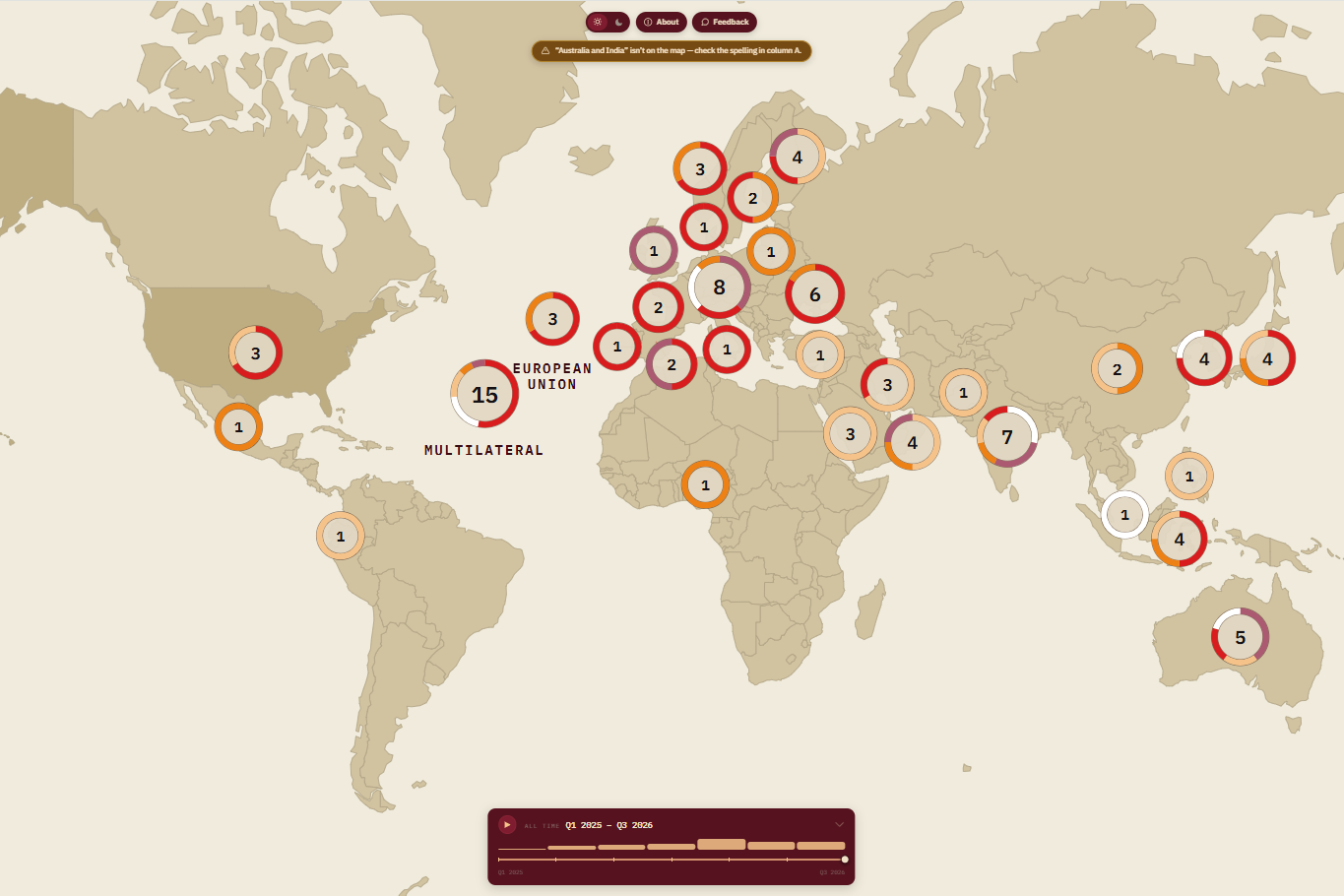
Mapping Canada’s Variable Geometry
In partnership with the Canadian Shield Institute and the Gloves Off podcast SCP built a map of Canada's new international agreements.
Social Capital Partners’ 2026 Federal Pre-Budget Submission
Canada must mobilize all the tools at our disposal right now to build a strong, sovereign, resilient economy.
Built to Reach: How institutional accountability shapes the reach of financial systems
Canada needs a greater diversity of accountability in financing institutions to reach all our viable enterprises.