
By Matthew Mendelsohn and Jon Shell
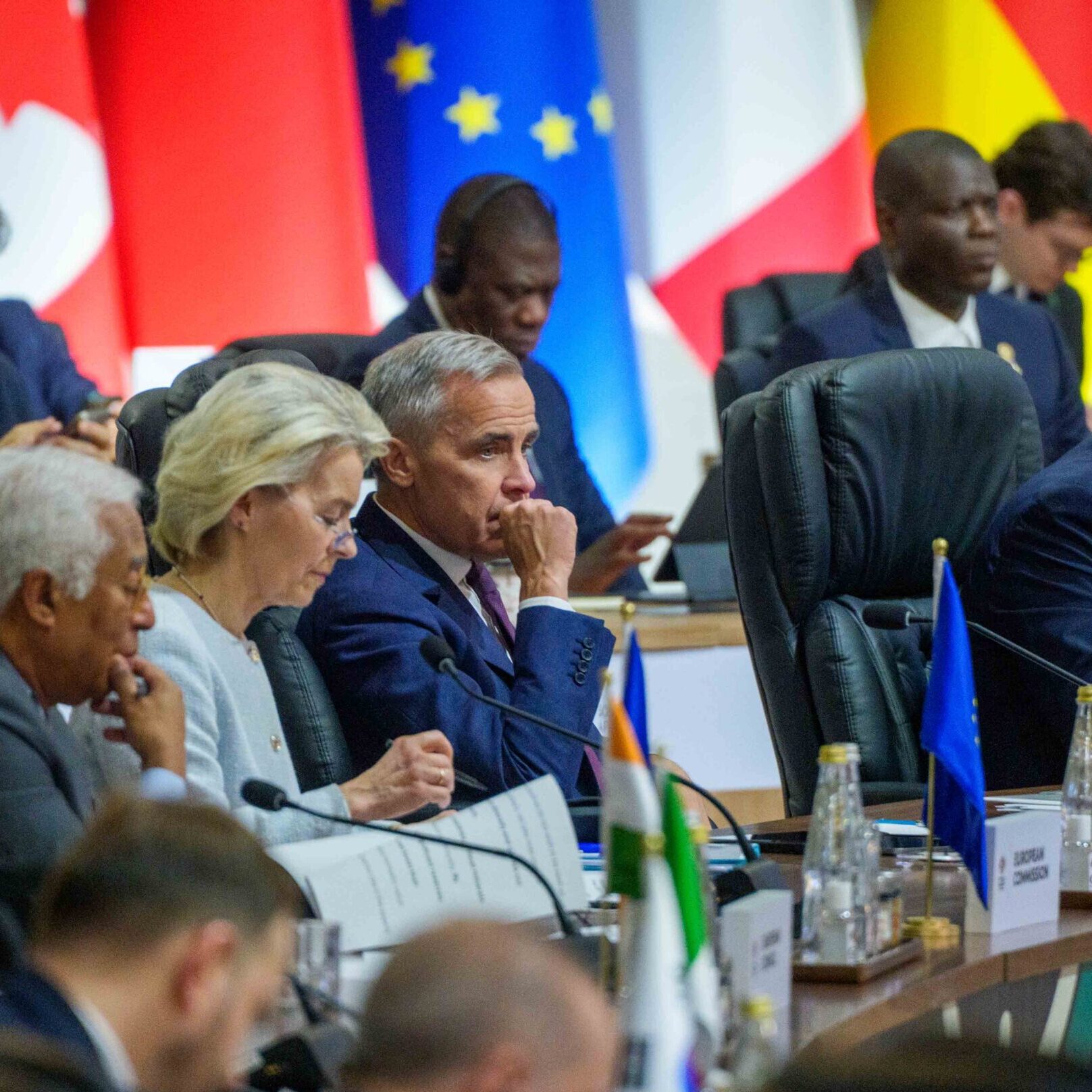
Mark Carney’s recent speech at the World Economic Forum matters because it says plainly what too many leaders have avoided saying out loud: middle powers like Canada are not powerless, but we have been acting as if we are.
We have been “living within the lie” of mutual benefit with our outsized and increasingly erratic neighbour. But the good news is that discarding that façade makes it possible to remake our alliances in ways that could actually shore up our economy and better secure prosperity and well-being for Canadians.
“I submit to you all the same that other countries, in particular middle powers like Canada, aren’t powerless,” the prime minister said. “They have the power to build a new order that integrates our values, like respect for human rights, sustainable development, solidarity, sovereignty and the territorial integrity of states.”
At Social Capital Partners, we welcome the clarity of this call for a new order. It aligns with a clear-eyed understanding of how fragile the current global order has become, how its benefits are unevenly distributed and how badly it serves those without leverage. The vision also aligns with our deepest hopes to live in a world of peace, equality and democracy.
We are under no illusions.
There are valid critiques of the speech. It did not clearly name the role that decades of unrestrained capital have played in making peoples’ lives worse, delivering us to this moment. It didn’t identify that the very promoters of that system were sitting in the room with him in Davos. And it did not fully acknowledge Canada’s own habit of talking tough while failing to follow through.
All of that is true.
It’s also true that Canadians have made a series of choices over many decades that have left us deeply exposed. We do not own our digital infrastructure. We haven’t sufficiently protected the Arctic. We didn’t maximize our natural resources and lack sovereign industrial and defence capacity. We understand that Canada must choose which battles we will fight.
Carney stopped short of calling out Donald Trump by name but was blunt and overt in his rejection of what he called the mere illusion of sovereignty.
“When we only negotiate bilaterally with a hegemon,” he said, “we negotiate from weakness. We accept what is offered. We compete with each other to be the most accommodating. This is not sovereignty. It is the performance of sovereignty while accepting subordination.”
Oof. This line should land hard in Canada, because it describes much of our recent experience. We invoke independence while structuring our economy, trade and infrastructure around dependence. We describe integration as mutual benefit even when it leaves us vulnerable to coercion.
The system worked—for some. For many others, it did not. Naming that truth is a prerequisite for rebuilding legitimacy and a better global system.
Crucially, the speech did not lapse into fatalism, and many around the world have even characterized it as a rallying cry. He explicitly rejected the idea that smaller states must submit to the logic of greater powers, arguing that middle powers have real power if they choose to exercise it together.
This is not a sentimental claim.
Taken together, some of the world’s middle-power democracies, which Jon has previously suggested could include Canada, Japan, South Korea, Australia, France, Germany, Italy, the U.K., Spain and the Netherlands, would amount to about the same GDP as the U.S., with about six hundred million wealthy residents with massive buying power. Taken together, we also have vast natural resources, enormous pools of capital, many of the world’s most innovative firms and significant military and industrial capacity. We are among the most attractive places on earth to live in and invest in.
This is not marginal power. It is simply unorganized power.
That is why Carney frames the choice so starkly: “In a world of great power rivalry, the countries in between have a choice: to compete with each other for favour or to combine to create a third path with impact.”
The offering of a new Middle Power Alliance is compelling: we all believe in democracy, equality and freedom. We believe in international trade and the dignity of all people. And together, these commitments produce human well-being, prosperity and progress.
Competing for favour leads to fragmentation and a race to the bottom. Coming together opens the possibility of something more durable—and a hopeful vision that people and democracies can build something better.
“Collective investments in resilience are cheaper than everyone building their own fortress,” Carney told the group at Davos. The real question is not whether middle powers must adapt, because of course we must, but whether we adapt defensively or ambitiously.
Ambition here would mean countries coming together in a new way to share the load and think big: joint digital infrastructure, coordinated industrial policy, common standards, collective security where geography demands it and new multilateral institutions in areas like climate, health and research. We have done things like this before, and successes like the International Space Station are proof that advanced democracies can build together when we choose to.
Trump has made it perfectly clear that tariff threats to Canada are the new baseline. There is no winning strategy in standing alone; there is only waiting to be pressured again.
Coercion works when countries are isolated and fails when pressure triggers collective response. Especially on the heels of Carney’s speech being called “the most important foreign policy speech in years” by the likes of the BBC and The New York Times, Canada has a role to play in building this alignment.
The form of this middle-power group can vary—maybe it’s those core 10 countries, maybe you’d add Mexico, Brazil and the Scandinavians; maybe it’s NATO minus the U.S. plus a few key others, like South Africa. The group will undoubtedly grow over time. The big shift is that the alliances among democratic nations must be built without U.S. leadership. And, must show that democracy delivers real benefits to its people, so that the group grows and emerging economies have real allies—not just threats to fall in line.
Carney’s speech matters because it treats this moment as a rupture, not a passing disruption. It’s in this rethink that there is also relief: “From the fracture, we can build something better, stronger and more just,” he said. “This is the task of the middle powers.”
Whether or not this becomes a turning point depends on what comes next.
If the speech is met with caution and retreat, it will fade. If it becomes a mandate to build institutions, alliances and capacity, it could mark the beginning of a genuine third path to security and shared prosperity—out of a world drifting toward coercion and into one shaped by cooperation.
For the first time in a long while, that path is visible. More hope is possible. More ambition is possible. We have the power; we just have to organize. So, middle powers, unite!
Share with a friend
Related reading
Built to Reach: How institutional accountability shapes the reach of financial systems
Canada needs a greater diversity of accountability in financing institutions to reach all our viable enterprises.
How Private Equity Extracts Value From the Economy | The Walrus Talks
SCP Fellow Rachel Wasserman explains how private equity firms are extracting value from Canadian businesses.

Getting capital into local businesses and communities must be part of Canada’s investment strategy
Getting capital into local businesses and communities must be part of Canada's investment strategy.