
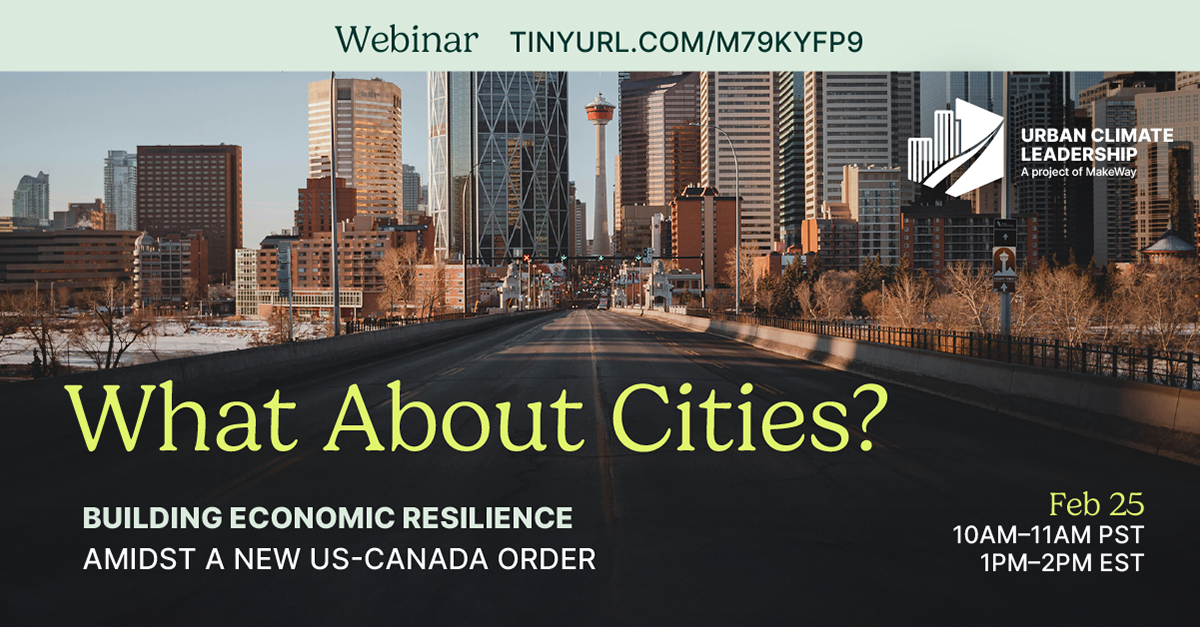
Join moderator Shauna Sylvester for an Urban Climate Leadership online webinar featuring Mary Rowe, CEO of Canadian Urban Institute, Mairin Loewen, Assoc. Program Director at UCL and Matthew Mendelsohn, CEO at Social Capital Partners in discussion on the impact of U.S. tariffs on Canadian cities.
February 25, 2025 from 1:00 – 2:00 p.m. ET.
Panelists
Mairin Loewen
Associate Program Director, Urban Climate Leadership
Matthew Mendelsohn
CEO, Social Capital Partners
Moderator
Shauna Sylvester
Lead, Urban Climate Leadership
Share with a friend
Related reading

Cross Check: How Canada Wins at Tech (Ep. 6) | Stephen Marche, Jon Shell and Vass Bednar
Stephen Marche, Jon Shell and Vass Bednar break down the details of "How Canada wins at tech"

Cross Check: How Canada Wins at Defence (Ep. 5) | Stephen Marche, Jon Shell and Vass Bednar
Stephen Marche, Jon Shell and Vass Bednar break down the details of "How Canada wins at defence"

Cross Check: How Canada’s Economy Can Thrive (Ep. 4) | Stephen Marche, Jon Shell and Vass Bednar
Stephen Marche, Jon Shell and Vass Bednar break down the details of "How Canada's Economy Can Thrive"