

By Jean-François Daoust, Liam O'Toole and Jacob Robbins-Kanter | This post originally appeared in Policy Options
The well-documented cost-of-living crisis plaguing young Canadians has triggered deep anxiety about their future – whether they can build stable careers, afford homes or one day raise families.
This is not only an economic problem. It’s a political one. As intergenerational inequality persists and deepens, Canada risks experiencing an even sharper decline in trust in its democratic institutions than what already exists.
To combat this, our political leaders must be willing to make difficult tradeoffs that rebalance priorities toward the young. That means rethinking tax incentives, addressing budget deficits that will fall on future generations and ensuring public spending supports those still trying to build their lives, not just those comfortably established – the group that is the focus of most politicians today.

The young face widespread problems
Home ownership, which has been a cornerstone of middle-class security for decades, is now one of the clearest markers of generational division. For most young Canadians, even saving for a down payment has become very challenging.
As existing homeowners’ properties have ballooned in value at the same time, the housing market has become a mechanism of (unequal) wealth transfer from the young to the old – reinforced by governments that are reluctant to confront politically powerful older homeowners.
The broader economic picture for younger Canadians also offers little hope. Wages have stagnated while costs have soared. Young Canadians are more educated than any previous generation, yet many work at precarious jobs with low pay, unstable hours and few benefits. Student debt and unaffordable child care make it harder to build savings or start families. Indeed, many people are reluctant to have the number of children they would like.
Previous beliefs that education and effort can lead to upward mobility no longer ring true. Instead, young Canadians face economic realities that demand more but give back less.
Politicians listen to older voters, not the young
This economic frustration runs hand-in-hand with political alienation. Older Canadians vote in greater percentages, contribute more to political campaigns and therefore wield disproportionate influence. Politicians cater to their interests and make sure to focus on the issues most important to older citizens.
Younger voters, facing economic instability and disillusionment, are increasingly disengaged from the political process, which only perpetuates their exclusion. This negative feedback loop erodes faith in democracy itself because young Canadians increasingly view politics as unresponsive to their needs.
The effects of this generational divide are already visible in Canada’s political landscape. Young Canadians vote at significantly lower rates than their older counterparts. In the 2021 federal election, only about 46 per cent of eligible voters aged 18 to 24 cast a ballot, compared with nearly 75 per cent of those 65 and older.
Surveys also show that younger Canadians express less confidence in elected officials, political parties and government institutions than any other age group. Many believe that no party truly represents their interests and that the political system is stacked in favour of homeowners and retirees.
It’s time to act
For younger generations, other forms of civic engagement, such as volunteering or signing petitions, may soon see further declines, according to a 2022 federal government report. This erosion of political participation is not apathy born of ignorance, but frustration born of exclusion. It’s a warning sign that Canada’s democracy is losing the trust of its future citizens.
Meanwhile, Canada faces a demographic reckoning. As Baby Boomers retire, health care and pension costs will balloon, to be financed by a smaller, economically strained population.
Younger Canadians, already struggling with stagnant incomes and rising costs, are delaying or forgoing having children altogether. This creates a vicious cycle: fewer workers to support an aging population and an ever-heavier fiscal burden. If left unaddressed, this imbalance threatens not just economic sustainability but trust in Canada’s political institutions.
If these trends persist, resentment among younger generations will likely deepen. Some will turn to political apathy. Others may seek more radical movements or figures that promise to upend a system they see as rigged against them. Once trust in the political system is lost, rebuilding it will be far more difficult than preventing its collapse.
To understand the extent of these challenges, we first need better data that illustrate younger generations’ political preferences and interests. These views should then be more effectively communicated to those in positions of political power – ideally resulting in improved representation. Some activists, notably the think tank Generation Squeeze, are already carrying out this work.
Canada needs a generational reset – one that puts fairness at the centre of political life. Building affordable housing and supporting young families are essential first steps.
The longer Canada ignores generational inequality, the greater the risk of political fragmentation and social anger. A healthy democracy depends on engaged citizens and political trust across generations. Today, this is running dangerously low among our younger people.
Share with a friend
Related reading
Advice to the public service: Five ways to confront monsters and chaos
Canada's political and bureaucratic leaders are quickly trying to re-wire the federal government to confront a belligerent Unites States, but systems can’t deliver what they were not designed for. This is a time like no other in our history, writes Matthew Mendelsohn, and those making decisions have not been trained for this—because we haven’t experienced anything like this before. Drawing on his own time in Ottawa, he walks us through five priority “machinery of government” changes our public service needs to make to meet the threat of an increasingly authoritarian, imperialist America.

Four key steps can help secure Canadian sovereignty
Gas station giant Parkland is already shedding Canadian employees in the wake of TX-based Sunoco’s recent takeover of the Canadian fuel chain, which owns 15% of our gas stations and a key refinery in Burnaby, B.C. These layoffs were a predictable outcome of Ottawa's decision not to flex its new regulatory muscle through the Canada Investment Act to quash foreign investment deals that pose an economic security threat. As SCP chair Jon Shell writes, the government has not defined a clear strategy to build and maintain Canadian ownership of our assets. Combined with the federal budget’s focus on attracting private capital, there’s a real danger that Ottawa will enable a sell-off of Canadian firms to foreign investors.
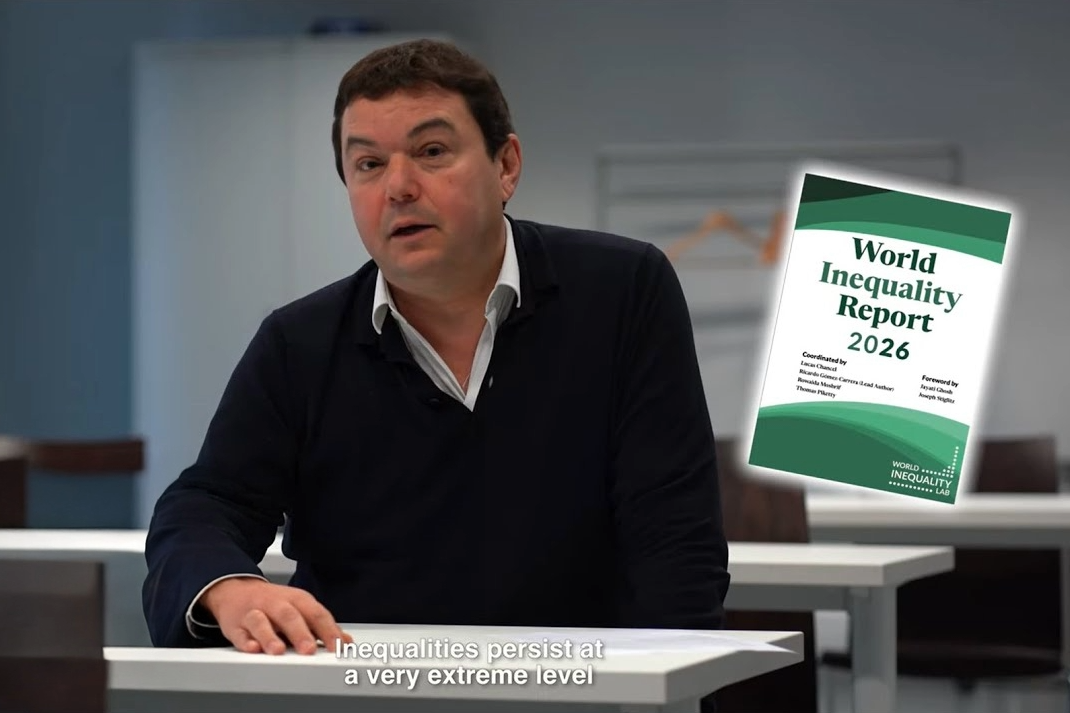
What the new World Inequality Report tells us, and why it matters for Canada
The 2026 World Inequality Report is out and the results paint a picture of a world in which a tiny minority commands unprecedented financial power, while billions remain excluded from even basic economic stability. As SCP Director of Policy Dan Skilleter writes, Canada is far from immune to these global trends: although our own GDP keeps rising, wealth gains have been concentrated at the very top, while many households struggle to afford food and housing. The top 1% in Canada hold about 29.3% of total wealth, making our country's wealth inequality even more pronounced than our own Canadian Parliamentary Budget Officer reports. The good news is, momentum is building in Canada for better wealth data, shedding light on our "Billionaire Blindspot."