

By Neil Corbett | This article first appeared in the Maple Ridge-Pitt Meadows News
A company based in Maple Ridge has made some business history, becoming the largest Employee Ownership Trust in Canada, and the first from the social services sector.
Taproot Community Support Services, which has 750 employees in B.C., Alberta, and a small number in Ontario, announced this week that an Employee Ownership Trust (EOT) acquired a majority share of the business. All employees have an equal shares in the company.
Taproot is the largest company to become EOT-owned since the federal government introduced this ownership model in 2024.
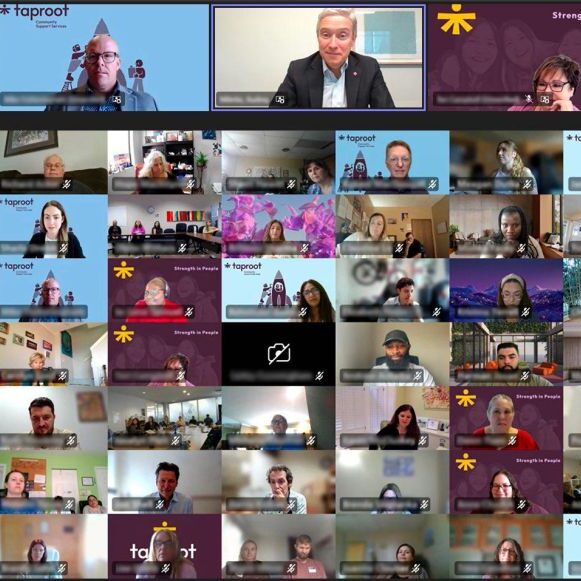
On an online call with the company CEO and the federal finance minister, Maple Ridge-based employee Kam Kaur offered her enthusiastic endorsement of the transaction.
“I’m really excited about being an owner. This is something to boast about, I’m going to boast about this with my friends,” she enthused.
She talked about how rare it is for a company to come under the ownership of its workers.
“This feels like you’re being valued,” Kaur added. “For me, this is the first thing I’m owning in Canada, so I’m really happy about it.”
CEO Mike Fotheringham said there is no financial risk for the employees. In fact, they will share in dividends. Last year, the company had a surplus of $1.6 million on $61 million in revenues, and he anticipates most employees will see dividends of approximately $1,000 to $1,500 per year, in addition to their wages.
“They keep a little extra money in their jeans, and share in our success,” he said.
He noted it’s a stable company, having been around about 42 years since it was founded in Maple Ridge.
“This is the next natural step in the evolution of our company,” said Fotheringham. “Becoming an EOT brings our inclusive values to life, makes all our employees true partners in our purpose-driven success, and ensures our company will remain locally grounded and Canadian-owned for the long term.”
The federal government voiced enthusiasm for the change.
“Taproot’s move to an Employee Ownership Trust is a game changer. It not only secures its future and empowers its team, but it also guarantees that the vital services children, youth and adults depend on will continue,” said the Finance Minister François-Philippe Champagne.
“This is a perfect example of what EOTs can do – they’re a powerful, timely tool that helps Canadian employees become owners of the businesses they work for, while helping entrepreneurs find the right people to carry their legacy forward,” he added.
Taproot provides support services to adults with diverse abilities, as well as vulnerable youth and families, supporting nearly 2,000 clients a year across 70 sites. They support clients in Maple Ridge, Langley, Surrey and across B.C. and Alberta. There are about 30 employees working in Maple Ridge.
Prior to the transition, Taproot was owned by a group of approximately 30 longtime and prior employees, some of whom were retired. Canada’s introduction of EOTs created a succession pathway that put the organization’s future into the hands of its workforce. Now every employee will have a stake in the business.
“We’ve worked hard, so it’s really nice to be rewarded for that, especially as frontline workers,” said Talica Bautarua, a community support worker at Taproot. “It feels like we’re in it together more now.”
Share with a friend
Related reading

Why Canada should back employee ownership trusts for the long term | TheFutureEconomy.ca
Established in 2024, Employee Ownership Trusts (EOTs) allow business owners to sell their companies to a trust held on behalf of employees, keeping firms in Canadian hands, building worker wealth and strengthening local communities. Jon Shell makes the case for EOTs in TheFutureEconomy.ca. With a temporary capital gains tax exemption set to expire in 2026, he and other advocates are urging the federal government to make the incentive permanent before momentum stalls.

How Employee Ownership Trusts keep wealth in Canada | Canadian Business
The coming wave of business successions will shape Canada’s economy for generations. In Canadian Business, Jon Shell explains how employee ownership safeguards economic sovereignty, while boosting growth, productivity and local wealth, giving employees struggling with affordability a new source of income. As entrepreneurs and owners seek alternatives to selling abroad, the employee ownership trust (EOT) provides a practical answer. Instead of letting the EOT tax incentive expire at the end of 2026, now is the time for the government to double down on employee ownership.

A housing boom isn’t a win for wealth equality and here’s why
Canada's wealth gap appeared to narrow between 2019 and 2023 and we set out to make sense of this. SCP's Director of Policy Dan Skilleter, the lead author on our 2024 Billionaire Blindspot report, connected with sector colleagues working on wealth concentration and dug into all the best available data. What he found was that the dip was largely a mirage, driven by a pandemic housing boom that temporarily inflated the one asset ordinary Canadians hold: their home. Meanwhile, these soaring prices locked out an entire generation from building wealth altogether.