Traditional paths to building wealth and achieving financial security in Canada are more uncertain than they’ve ever been. View our Fast Facts.
It’s more difficult for young people to own a home, starting a business is harder than ever and jobs outside the public sector rarely have pension plans. Most Canadians don’t have enough savings to get through a crisis or a bit of bad luck.
Many programs designed to help people build assets work pretty well for middle- and upper-income Canadians, but not for everyone. For those with precarious employment and financial vulnerability, Canada needs better solutions.
Public policy can respond in real ways to help working people acquire assets and build savings – and protect consumers from predatory firms taking advantage of their market power.
At SCP, we are designing policies that ensure more Canadians can build economic security and championing ideas that prevent corporate giants from exploiting consumers.

On this topic

Toronto is piloting a city-owned grocery store. Could it help fight high food prices?
Toronto City Council has approved initial steps toward a city-owned grocery store pilot to increase competition and drive down food prices. The move addresses growing concern over Canada's grocery oligopoly, where major chains have posted outsized profits—a trend critics link to "sellers' inflation" since COVID. SCP's CEO Matthew Mendelsohn sees the pilot as a promising step toward public ownership models that prioritize affordability over investor returns.

Why Canada should back employee ownership trusts for the long term | TheFutureEconomy.ca
Established in 2024, Employee Ownership Trusts (EOTs) allow business owners to sell their companies to a trust held on behalf of employees, keeping firms in Canadian hands, building worker wealth and strengthening local communities. Jon Shell makes the case for EOTs in TheFutureEconomy.ca. With a temporary capital gains tax exemption set to expire in 2026, he and other advocates are urging the federal government to make the incentive permanent before momentum stalls.

How Employee Ownership Trusts keep wealth in Canada | Canadian Business
The coming wave of business successions will shape Canada’s economy for generations. In Canadian Business, Jon Shell explains how employee ownership safeguards economic sovereignty, while boosting growth, productivity and local wealth, giving employees struggling with affordability a new source of income. As entrepreneurs and owners seek alternatives to selling abroad, the employee ownership trust (EOT) provides a practical answer. Instead of letting the EOT tax incentive expire at the end of 2026, now is the time for the government to double down on employee ownership.

A housing boom isn’t a win for wealth equality and here’s why
Canada's wealth gap appeared to narrow between 2019 and 2023 and we set out to make sense of this. SCP's Director of Policy Dan Skilleter, the lead author on our 2024 Billionaire Blindspot report, connected with sector colleagues working on wealth concentration and dug into all the best available data. What he found was that the dip was largely a mirage, driven by a pandemic housing boom that temporarily inflated the one asset ordinary Canadians hold: their home. Meanwhile, these soaring prices locked out an entire generation from building wealth altogether.

Watch the video: The risks and benefits of opening up private markets to everyday investors
The Ontario Securities Commission wants to give retail investors access to private markets. But as Rachel Wasserman tells BNN Bloomberg, when you look closely, it starts to look less like democratization and more like offloading risk onto people with the least power to absorb it. Private equity is already underperforming and PE's biggest historical champions are quietly reducing their exposure. This proposal to offer retail investors access to PE stands to benefit the asset managers and intermediaries, with everyday investors bearing the costs and risks.
Watch the video: Why would a company sell to its employees?
Canada is facing a $2-trillion business handoff. What if employees owned more of it? In this video, our Director of Policy Dan Skilleter explains why a company would sell to its own employees, how it happens and who stands to benefits. Spoiler alert: employee-owned companies are shown to be 8-12% more productive, share more wealth with their workers, keep businesses Canadian-owned and shore up the resilience of local communities and the broader economy.
From Guidelines to Action: Feedback on the proposed Merger Enforcement Guidelines
The Competition Bureau's proposed Merger Enforcement Guidelines represent meaningful progress against trends towards corporate consolidation in Canada. In our formal feedback submission to the bureau, Social Capital Partners outlines that we strongly support the new guidelines. However, we believe that the operationalization of these guidelines will be the real test of their impact. Guidance documents shape expectations, but enforcement outcomes shape behaviour. Serial acquirers are sophisticated actors who model regulatory risk into their strategies. To succeed, the bureau must demonstrate visible capacity to track, analyze and challenge roll-up patterns that are driving up prices and sacrificing quality and service in key sectors.

A youth employment supplement could rebalance Canada’s generational divide | Policy Options
Canada is overdue for a broader debate on intergenerational fairness and how our taxes and benefits support—and exclude—different age groups. As Kiran Gill and Matthew Mendelsohn explain in Policy Options, we continue to live with programs designed by baby boomers to provide security to seniors, even if those seniors are well off. Meanwhile, young adults in our country face challenges entering the labour market, securing stable employment and saving to build some measure of economic security in the face of rising costs. They propose a policy designed to make the economy work for younger Canadians—a youth supplement to the existing Canada Workers Benefit. This youth employment supplement—aptly coined a YES!—could help rebuild financial security and allow younger adults to buy homes, finance education for themselves or their children and save for the future.

Advocates urge Ottawa to extend ‘no-brainer’ tax incentive for employee ownership | CTV News
The federal government first proposed tax changes to facilitate employee ownership trusts in 2023. One of the key measures included in the fall economic statement that year offers a $10-million capital gains tax exemption to owners who sell their companies to their employees through the trust mechanism. But, as CP's Craig Lord writes, that exemption was only planned for three years and is set to expire at the end of 2026, unless the federal government moves to extend the measure. Advocates for employee ownership trusts say letting the tax exemption expire would undercut the model before it’s given a chance to shine.
Sign the open letter | Make the Employee Ownership Trust incentive permanent
Employee Ownership Trusts (EOTs) offer a practical succession pathway that keeps businesses Canadian-owned, empowers employees to share in the value they help create and supports long-term investment in our communities. With the right policy support, employee ownership can be a strong, proven path forward for Canada’s economy. If this is something you support too, you are invited to read and sign Employee Ownership Canada’s national open letter.
Watch the video: Are foreign takeovers good for Canada’s economy?
We all want more investment in Canada's economy. But as SCP Chair Jon Shell explains in this video, when it comes to foreign investment in the Canadian economy, or FDI, we have to ask: is it investment that builds? Or investment that buys? Because these are two very different things.
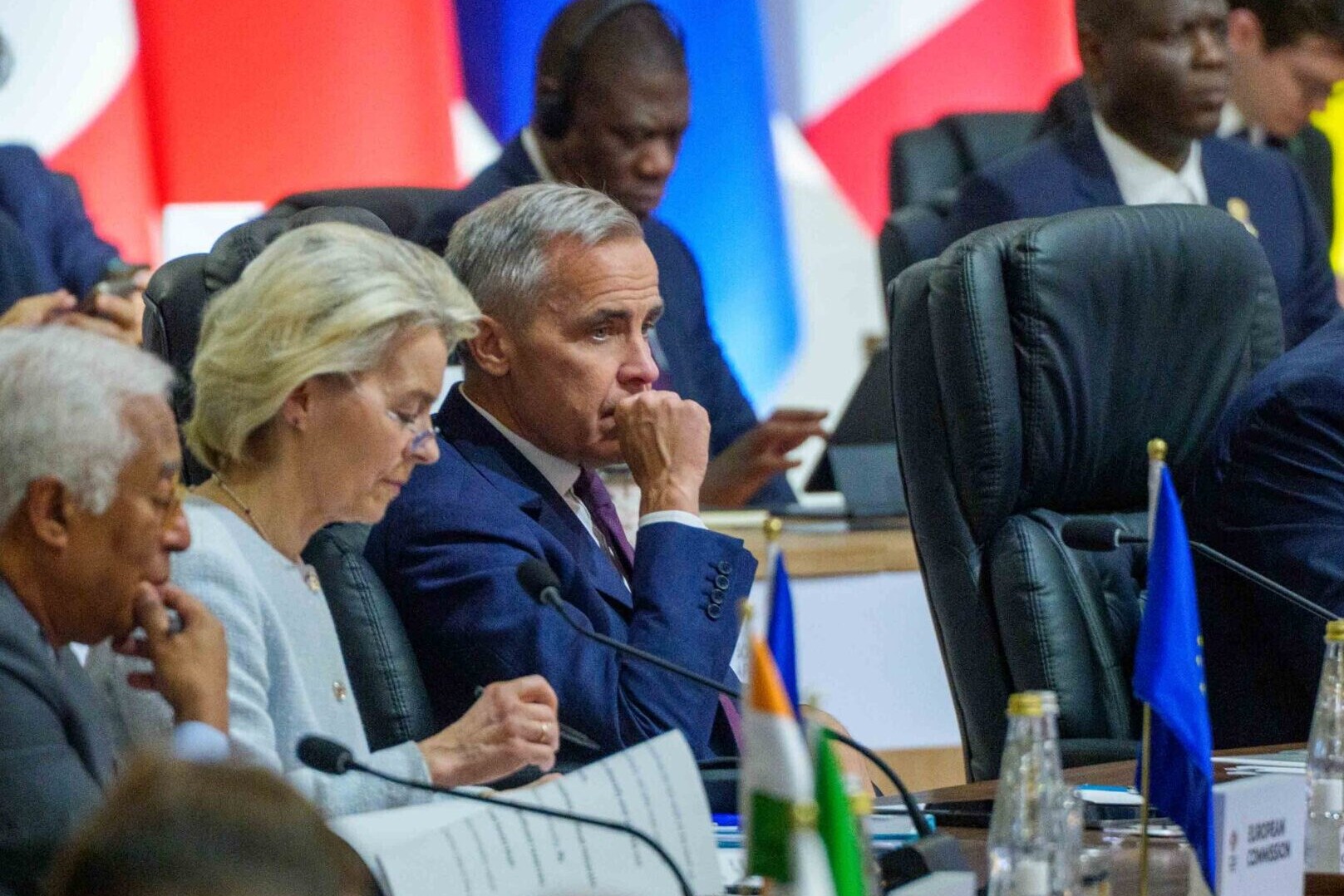
Mark Carney’s Davos speech is a manifesto for the world’s middle powers
Mark Carney's recent speech at Davos matters because it treats this moment as a rupture, not a passing disruption. It’s in this rethink, write Matthew Mendelsohn and Jon Shell, that there is also relief: “From the fracture, we can build something better, stronger and more just,” Carney said. “This is the task of the middle powers.” The world's middle powers are not powerless, but we have been acting as if we are, living within the lie of mutual benefit with our outsized and increasingly erratic neighbour. Without the U.S., the world's middle-power democracies are rich, powerful and principled enough that we can unite to advance human well-being, prosperity and progress.

Four reasons our economy needs employee ownership now
Employee ownership offers a timely solution to some of Canada’s most pressing economic challenges, writes Deborah Aarts in Smith Business Insight. Evidence shows that when employees share ownership, businesses become more productive, innovative and resilient. Plus, beyond firm-level gains, employee ownership can help address the coming mass retirement of business owners, protect local economic sovereignty, boost national productivity and reduce wealth inequality. There is enough data about the brass-tacks benefits of employee ownership to sway even the most hardened skeptic.

Budget was missing a Canadian ownership strategy
Gas station giant Parkland is already shedding Canadian employees in the wake of TX-based Sunoco’s recent takeover of the Canadian fuel chain, which owns 15% of our gas stations and a key refinery in Burnaby, B.C. These layoffs were a predictable outcome of Ottawa's decision not to flex its new regulatory muscle through the Canada Investment Act to quash foreign investment deals that pose an economic security threat. As SCP chair Jon Shell writes, the government has not defined a clear strategy to build and maintain Canadian ownership of our assets. Combined with the federal budget’s focus on attracting private capital, there’s a real danger that Ottawa will enable a sell-off of Canadian firms to foreign investors.
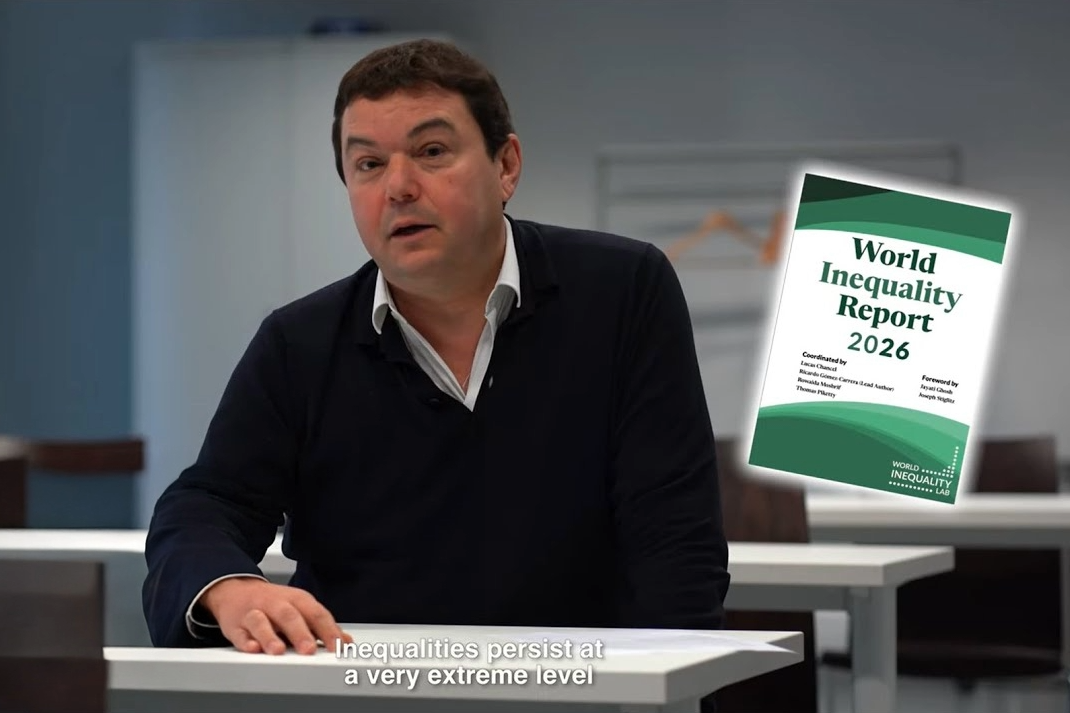
What the new World Inequality Report tells us, and why it matters for Canada
The 2026 World Inequality Report is out and the results paint a picture of a world in which a tiny minority commands unprecedented financial power, while billions remain excluded from even basic economic stability. As SCP Director of Policy Dan Skilleter writes, Canada is far from immune to these global trends: although our own GDP keeps rising, wealth gains have been concentrated at the very top, while many households struggle to afford food and housing. The top 1% in Canada hold about 29.3% of total wealth, making our country's wealth inequality even more pronounced than our own Canadian Parliamentary Budget Officer reports. The good news is, momentum is building in Canada for better wealth data, shedding light on our "Billionaire Blindspot."

Ontario wakes up to the succession tsunami
In November, 2025, the Ontario provincial government finally stepped into the looming “succession tsunami,” launching a modest $1.9M Business Succession Planning Hub to help micro-business owners plan exits through local Small Business Enterprise Centres. Notably, the hub spotlights employee ownership and the new Employee Ownership Trust, signaling a shift toward mainstream adoption. But, as Dan Skilleter writes, Ontario’s approach focuses narrowly on retiring owners, ignoring how different buyers shape risks and benefits to workers, communities and Canada's broader economic sovereignty. This is a promising start that could and should grow into a broader succession-planning policy that protects Ontario’s long-term resilience.

Mapping the economic centre-left
The large and well-funded American blogosphere has a pretty wide array of economic voices and ideological camps within the centre-left tent. So big, in fact, that there’s a sub-genre of inter-blog conflict dedicated to people named Matt. Over the years, SCP Director of Policy Dan Skilleter has found it useful to categorize these various different centre-left ideological camps in his head. The categories are not mutually exclusive, and most people probably identify with a few at once. This explainer breaks down each camp's story about what’s wrong with the economy and how they’d prioritize dealing with it.

How intergenerational inequality threatens trust in democracy | Policy Options
Our political leaders must be willing to make difficult tradeoffs to rebalance policies toward the young and away from older Canadians, write Jean-François Daoust, Liam O'Toole and Jacob Robbins-Kanter in Policy Options. The broader economic picture for younger Canadians offers little hope, and economic frustration is shown to run hand-in-hand with political alienation. As intergenerational inequality persists and deepens, Canada risks experiencing an even sharper decline in trust in its democratic institutions than what already exists. Building affordable housing and supporting young families are essential first steps in a much-needed generational reset that puts fairness at the centre of Canadian political life.
Smith School of Business launches new Employee Ownership Research Initiative
Smith School of Business at Queen's University is launching Canada's first-ever research initiative focused on deepening Canada’s knowledge and understanding of a powerful succession model that can enhance outcomes for owners, employees and communities: employee ownership. With funding support from Jon Shell, the EORI will be housed in Smith’s Centre for Entrepreneurship Innovation & Social Impact (CEISI). The initiative will shape a made-in-Canada approach to employee ownership and create a multi-disciplinary network of academics, researchers, practitioners and businesses to fill gaps in relevant data, expertise and business-oriented resources to support employee-ownership activities across the country.

Elbows up: Keeping Canadian companies in Canadian hands | Policy Options
Blue Jays pride notwithstanding, many of Canada's most iconic companies and brands have been quietly but steadily purchased by foreign entities in recent years. As Danny Parys writes in Policy Options, policymakers should do more to keep Canadian companies in Canadian hands by providing more support to expand financing opportunities, expanding awareness of untraditional ownership models and beefing up Canada’s net-benefit review requirements. These quiet foreign sales not only lead to major frustrations for consumers, but workers also feel the impacts because, as corporate leadership moves further away from the community, so do quality and accountability.

Reflections on Budget 2025: Economic growth alone won’t save us
In this reflection on Budget 2025, SCP CEO Matthew Mendelsohn explains that we really like the Budget’s focus on industrial strategy, some tentative steps on making more capital available to a wider diversity of Canadians and commitments to loosen the grip that our oligopolistic sectors have over our economy. However, we are concerned by the lack of a strategic approach to providing more working people and young people a path to wealth, ownership and economic security. While the Budget responds to the wish list that corporate Canada has articulated for several years, there are no guarantees that they will indeed step up to invest—or that those investments will produce growth that benefits working people and communities.

Budget 2025 did not extend the $10M capital-gains exemption for sales through EOTs
We share the disappointment felt across Canada’s business and advisory community that Budget 2025 did not make the $10 million capital gains exemption for sales through Employee Ownership Trusts (EOTs) a permanent feature of Canada’s tax system. The current incentive, passed only in 2024 with an expiry set for December 2026, means that the business community has not had adequate time to act on this opportunity or build adequate momentum for this promising succession model. In this statement, Employee Ownership Canada responds to the Budget and reaffirms its strong commitment to working with government and partners to make the capital gains exemption permanent, ensuring employee ownership trusts remain a viable, long-term option for Canadian businesses.

FAQs on Budget 2025 and the future of Employee Ownership Trusts (EOTs) in Canada
There is some confusion out there about Budget 2025 and employee ownership trusts (EOTs). To confirm, the federal government did not extend the $10M capital-gains exemption for sales through EOTs, in the budget released on Tuesday, November 4, 2025. Because the sale of a business to an EOT is a process that often takes more than a year, certainty on the rules is essential for owners, advisors and employees planning succession. In this FAQ, Employee Ownership Canada answers key questions about what’s enacted now, why the incentive matters for uptake and how the sector, businesses and the organization are moving forward from the Budget news.

Codetermination and upskilling in the age of AI
So much uncertainty surrounding AI and its impact on jobs has many Canadian workers asking themselves, “who’s next?” With 60% of Canadian workers in roles at risk of AI-driven job transformations, business and political leaders are champing at the bit to automate workforces. As Danny Parys writes, with so many livelihoods at stake, it’s clear that the Canadian economy needs to make bold changes, such as taking a page from many European countries' books and building employee consultation into their governance models. Codetermination could not only help ensure that the productivity gains of AI and automation are realized, but that workers are consulted first.

Could increased employee ownership restore confidence in Canada’s economy? | The Hub
As companies consolidate under ever larger pools of private capital, there’s growing unease around who’s actually benefiting from corporate growth. Falice Chin writes in The Hub that it’s no coincidence, then, that voices across the political spectrum are now revisiting models of employee ownership as a potential antidote to widening wealth inequality, fading community ties and a growing distrust in capitalism itself. This deep-dive looks at how employee ownership trusts, or EOTs, could be an elegant policy remedy to a crisis of confidence in the modern economy.

Elbows up: A practical program for Canadian sovereignty | Report
Canada can’t become a sovereign country by doing the same old things, explains a new compendium of essays co-sponsored by the CCPA, the Centre for Future Work and several national civil society organizations. Elbows Up: A Practical Program for Canadian Sovereignty is a response to corporate rallying cries responding to Donald Trump with a familiar playbook: deregulation, austerity, tax cuts and fossil fuel expansion. The collection includes contributions from 20 progressive economists and policy experts, including SCP CEO Matthew Mendelsohn and others who participated in the Elbows Up Economic Summit held in September 2025 in Ottawa.

What’s wrong with mainstream economics?
Mainstream, or “neoclassical,” economics still dominates how we teach, study and understand our economy, even though much of it doesn’t match reality. In this piece, economists Louis-Philippe Rochon and Guillaume Vallet explain why outdated economic ideas persist and how they can lead to harmful policies. They challenge five common myths about inflation, growth and inequality, showing that today’s economy is driven more by power and institutions than by perfect markets. As "heterodox" economists, they argue it's time for a new kind of economics that reflects how the real world actually works.
Building a thriving economy: CSA Policy Pathways Conference
The CSA Policy Pathways Conference convenes leaders, thinkers and changemakers across government, business, community and academia to confront the pressing questions shaping our economic future. How can we build resilience in the face of global uncertainty? What will it take to unlock innovation and ensure its benefits are broadly shared? How do we design policies that promote competition, inclusion, and financial security? Join us on November 5, 2025, in Toronto, as we explore how we can take bolder steps toward a more resilient, innovative and equitable economic future.

Creativity could be collateral damage of U.S. film tariff
When U.S. tariffs threaten to strike creativity and culture, we can't afford to stay quiet. SCP Fellow and POV executive director Biju Pappachan explores the implications of the U.S. imposing a tariff on foreign-made films and explains why this is the moment for Canada to stand up for its filmmakers, crews and cultural sovereignty. Film and television are not luxuries; cultural production is a strategic sector that delivers exports, jobs and soft power. Just as we negotiate for agricultural or industrial tariff exemptions, cultural production deserves equal protection.

Hype or help? Can crypto and stablecoins solve economic inequality?
Some cryptocurrency advocates are promoting the use of stablecoins as a common currency, arguing that this new currency could help the cost-of-living crisis and promote economic equality – particularly for young people. Law professor, money expert and SCP Fellow Dan Rohde is not convinced that crypto can help address economic inequality. In this explainer, he breaks down what stablecoins are and aren’t, and how to think critically about their promises.

Budget 2025 should bolster employee ownership to strengthen Canada’s economy | Canadian Dimension
Budget 2025 offers Canada a chance to make employee ownership permanent by extending tax incentives for employee ownership trusts (EOTs) and worker co-ops. In Canadian Dimension, Simon Pek, Lorin Busaan and Alex Hemingway write that doing so would boost productivity, reduce inequality and secure business succession, while keeping jobs and decision-making local. A modest investment promises significant economic and social dividends.

What being an employee-owned company means to me
For what it’s like to be on the inside of an employee-owned company, we spoke to a few of the 750 employees who recently became 100-per cent owners of Taproot Community Support Services, a social services provider across B.C., Alberta and Ontario. Rewards the employees highlighted include company morale and spirit, for sure. They also include financial rewards paid out annually to each employee as dividends. Last year, each employee would have received about $1000 to $1500 on top of their salaries—and as the company succeeds over time, the employees will share financially in Taproot’s success.

Wealth inequality in Canada is far worse than StatsCan reports
Our government’s best available data on Canada’s wealth gap excludes, by design, the wealthiest families in the country. As SCP Director of Policy Dan Skilleter writes, if we didn’t have the Parliamentary Budget Officer fact-checking Statistics Canada’s work, their numbers would tell us the top one per cent own only 2.5 per cent of all wealth – not nearly 25 per cent of all wealth in Canada, as the PBO reports. We like to think of Canada as a beacon of egalitarianism compared to our southern neighbours, but when you add in data from "rich lists" published by Forbes and Maclean's, our wealth concentration looks quite similar to the U.S.
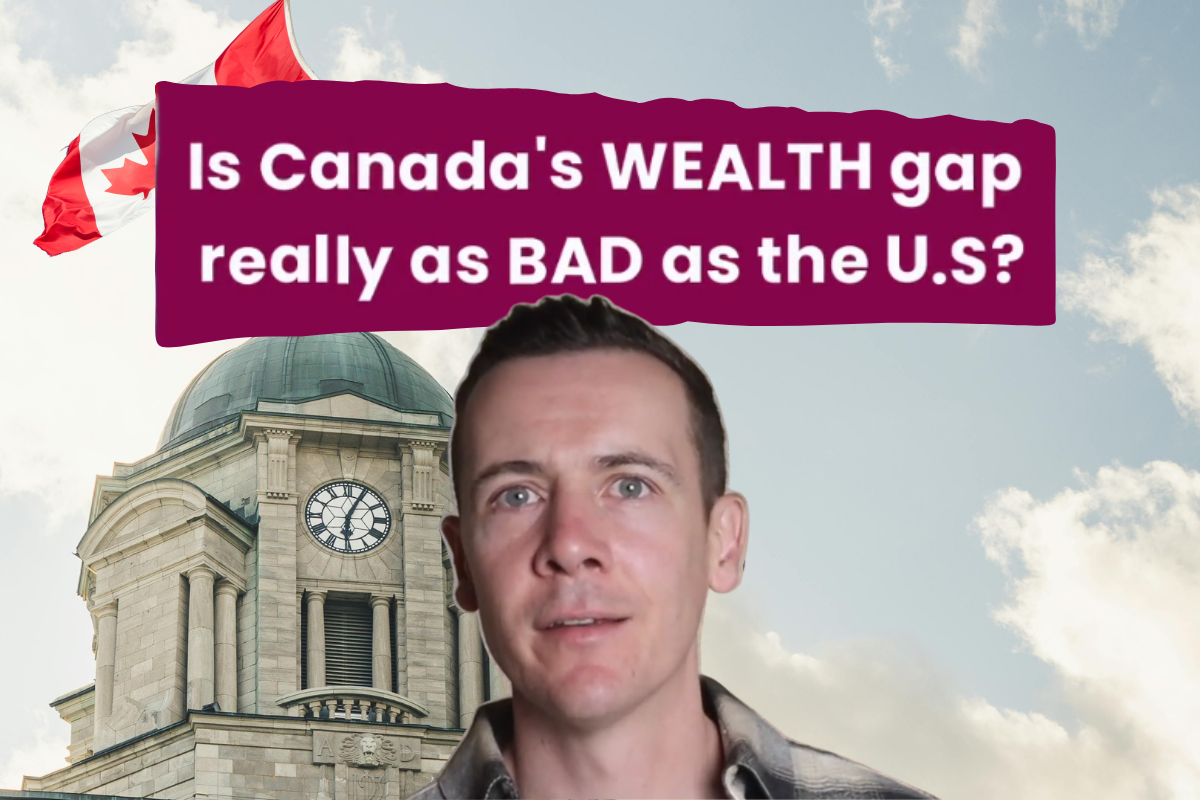
Watch the video: Is Canada’s wealth gap really as bad as the U.S?
As Canadians, we like to think we’re strong and free. But as SCP's Director of Policy Dan Skilleter explains, when it comes to the wealth gap, we're looking more like America Lite—better manners, but almost all the inequality. The way our economy is set up means that most of the benefits from economic growth go to financial interests and speculators, rather than to workers or other businesses. We can shift economic power to more people and aspiring entrepreneurs by making them owners. When more people have a stake, Canada’s economy works better for everyone—not just investors.

Build, baby, build. Or sell, baby, sell? Canada should reject Sunoco’s takeover of Parkland | Policy Options
Approving a sale of Parkland to Sunoco may be attractive to the government because it would add US$9 billion to Canada’s total foreign direct investment (FDI), which politicians often tout as an indicator of national economic health. But, as SCP Fellow Sarah Doyle and SCP Chair Jon Shell write, total foreign direct investment is not a good reflection of the underlying strength of the economy. Plus, this deal would bring none of the benefits typically associated with FDI. It is unlikely to lead to increased capital investment, more or better jobs, or technology transfer into Canada. In fact, its impact may be just the opposite. If there ever was a deal with almost no Canadian winners, this is it. Ottawa should say no to Sunoco.

The federal government is leaving investment dollars on the table—but it can fix that in the budget
At the recent Victoria Forum, community and philanthropic leaders outlined creative community finance and impact investment ideas that could mobilize big pools of private capital to invest in local businesses, social purpose organizations and community infrastructure. However, as SCP CEO Matthew Mendelsohn writes, despite the growing maturity of the social finance community, Canada still lacks the social and community financing infrastructure and policies to make this happen. With some important fixes to fragmented financing and outdated regulatory frameworks, the coming Budget could make it easier for social finance investments to properly scale and deliver the kind of outsized impact Canada needs at this time.

Acquisitions can’t build Canada: Understanding Foreign Direct Investment in an age of geopolitical fracturing
Levels of our country's Foreign Direct Investment, or FDI, do not actually tell us much about the state of the economy. One large deal can significantly affect total FDI inflows, which can vary dramatically from year to year. Plus, as SCP Fellow Sarah Doyle and SCP Chair Jon Shell write, not all FDI is created equal. Distinguishing between beneficial and harmful FDI is even more important now, in the context of a global trade war and threats to Canada’s economic sovereignty. In this explainer, they unpack FDI: what it is, when it is and isn’t beneficial and why understanding these nuances matters.
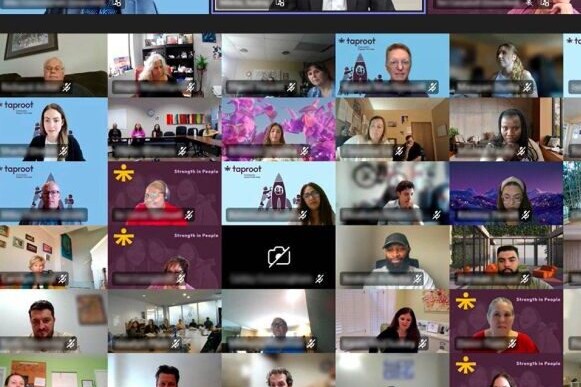
Maple Ridge-based company now owned by its 750 employees | Maple Ridge-Pitt Meadows News
Neil Corbett of the Maple Ridge-Pitt Meadows News reports on locally based Taproot Community Support Services making some business history in Canada. Taproot's 750 employees in B.C., Alberta Ontario will now own 100 per cent of the business, becoming the largest Employee Ownership Trust (EOT) in Canada and the first in the social services sector. Finance minister Francois-Philippe Champagne explains why this is a perfect example of what EOTs can do, calling the trusts "a powerful, timely tool that helps Canadian employees become owners of the businesses they work for, while helping entrepreneurs find the right people to carry their legacy forward."

Taproot becomes Canada’s largest employee-owned trust with 750 workers | The Globe and Mail
On Sept. 2, 2025, B.C.-based Taproot community support services surprised its 750 employees with the news they will become equal owners of the company they helped build. Minister of Finance & National Revenue Francois-Philippe Champagne joined CEO Mike Fotheringham and Social Capital Partners Chair Jon Shell to celebrate the new worker-owners and Canada’s largest Employee Ownership Trust (EOT) to date. In the Globe and Mail, Meera Raman reports on Taproot's milestone and how this succession model keeps companies Canadian, keeps jobs in local communities and builds wealth for workers.
Social Capital Partners’ 2025 Federal Pre-Budget Submission
There has never been a federal budget quite like this one. Canada faces a moment of extreme peril, threatened by an American administration that has abandoned our mutually beneficial trading and security regime. In our pre-budget submission, Social Capital Partners recommends that Budget 2025 focus on broadening ownership to ensure the benefits of economic growth are more widely shared. Policy choices should move us away from an economy fueled by wealth extraction that enriches billionaires and inflates the bottom lines of foreign funds, and instead, move us towards more local reinvestment that builds an inclusive, sustainable and resilient democratic future where all Canadians have realistic chances to build economic security.

How Canada’s tax system puts the wealthy above workers
Rather than using the tax system to prevent wealth concentration, our current tax system promotes it. Those who earn income from their investments have more income left over after taxes, allowing them to accumulate wealth more quickly than others. SCP Fellow Silas Xuereb explains how, south of the border, we are witnessing the consequences of runaway wealth inequality – billionaires use their media conglomerates to get political favours, exploit the instruments of the state to enrich themselves and, increasingly, secure political office. All of these trends are leading to the erosion of democracy and public policy that advances the interests of the wealthy at the expense of everyone else. If Canada does not rebalance our tax system to prioritize work over wealth, we may soon find ourselves on the same path.

Trump pumps private equity with 401k changes | Breaking Points podcast
Breaking Points podcast correspondent James Li sits down with corporate lawyer, economic analyst and SCP Fellow Rachel Wasserman to discuss Trump's executive order opening up 401k plans to private equity. Trends show that with rising interest rates and frozen exit markets, the private equity investment model could be under serious stress. So, what are the implications of making this type of investment available to retail investors and their retirement plans? Rachel walks James through how private equity works, what's so dangerous about the buyout-PE model and who might get left holding the bag.
The problem with GDP per capita | West of Centre on CBC
New research by economist and SCP Fellow Gillian Petit estimates what Canada’s GDP per capita would have been over the past decade if Canada had kept our temporary resident numbers stable. On CBC political podcast West of Centre, host Rob Brown asks Petit to dissect the metric politicians love to wield. GDP measures total output, while GDP per capita divides that sum by the population. She explains that the simple math offers an easy snapshot, but can mislead when used alone. For a true read on prosperity, Petit argues Canada needs a broader economic dashboard that weighs productivity, fairness and long term well being.
Blame the denominator, not the economy
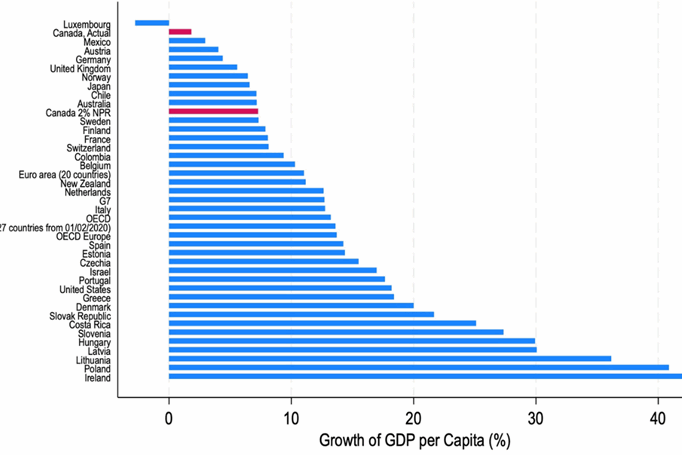
Over the last couple of years, there have been countless articles warning of Canada’s poor economic performance. The mic drop has increasingly been Canada’s poor performance relative to peer countries on “GDP per capita,” with growth rankings used to draw a variety of sweeping, negative conclusions about Canada’s economy. SCP CEO Matthew Mendelsohn and Policy Director Dan Skilleter draw on economist and SCP Fellow Dr. Gillian Petit's new research to explain why GDP per capita is a deeply flawed measurement for evaluating rich countries - and is easily influenced by a variety of factors having little to do with economic performance or economic well-being.

Non-Permanent Residents and their impact on GDP per capita | Summary
New research by economist and SCP Fellow Gillian Petit estimates what Canada’s GDP per capita would have been over the past decade if Canada had kept our temporary resident numbers stable. She also estimates the expected impact on GDP per capita in the coming years due strictly to planned reductions in Canada's intake of non-permanent residents. Among key findings: Canada’s GDP per capita is misleading and should not be used as if it were the sole indicator of economic well-being. Plus, if we had maintained our temporary resident numbers at two percent of the population in recent years, Canada’s GDP per capita would look much more like our peer countries: a little bit ahead of countries like Germany, the United Kingdom and Australia and a little bit lower than countries like Belgium, Sweden and France.
Non-Permanent Residents and their impact on GDP per capita | Report
New research by economist and SCP Fellow Gillian Petit estimates what Canada’s GDP per capita would have been over the past decade if Canada had kept our temporary resident numbers stable. She also estimates the expected impact on GDP per capita in the coming years due strictly to planned reductions in Canada's intake of non-permanent residents. Among key findings: Canada’s GDP per capita is misleading and should not be used as if it were the sole indicator of economic well-being. Plus, if we had maintained our temporary resident numbers at two percent of the population in recent years, Canada’s GDP per capita would look much more like our peer countries: a little bit ahead of countries like Germany, the United Kingdom and Australia and a little bit lower than countries like Belgium, Sweden and France.

How do we not go broke? | Gloves Off Podcast
What happens when a Canadian toy company, a global trade war and the unraveling of American stability collide? Charting in the top 10 on Apple Podcasts, the new Gloves Off podcast talks to Zita Cobb of Fogo Island Inn and Jon Shell of Social Capital Partners about what comes after the collapse of business as usual. Listen for bold ideas on how Canada can prevent getting stuck playing America’s game—and losing.
Mark Carney’s economic agenda misses something vital | Toronto Star
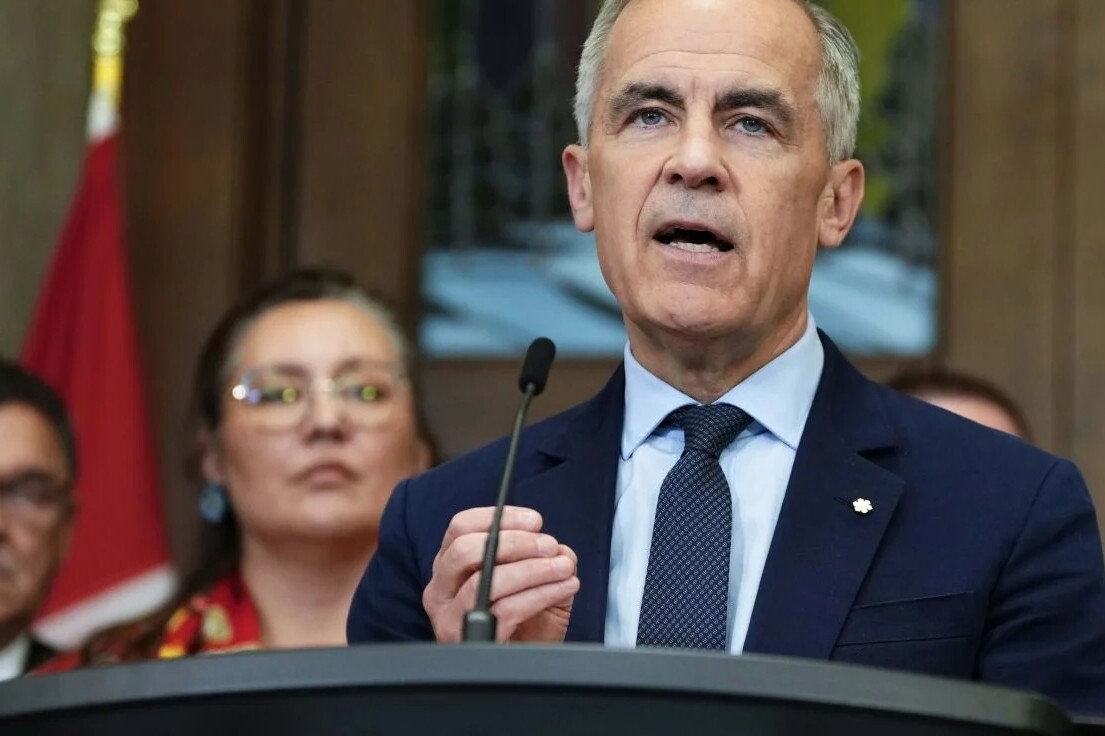
Prime Minister Mark Carney's campaign focused on economic growth and sovereignty. He talked a lot about how Trump wants to "break us so he can own us," and yet, so far, details of an ownership agenda are pretty thin. The reality is that Canadians cannot be "masters in our own home" if the home is owned by a U.S. hedge fund. Broadly distributed, local Canadian ownership of our economy and our assets must be a central part of our economic growth strategy. In the Toronto Star, SCP CEO Matthew Mendelsohn writes that he sees some early, positive signs of such a plan coming from the federal government and spells out what a real ownership agenda that serves "the owners of Canada" would look like.

HBS Case | Taylor Guitars: Making Employee Ownership Work the Taylor Way
After a successful transition to 100% employee ownership, Taylor Guitars' experience is now the subject of a Harvard Business School case. Read more about how their experience brings the evidence to life: "Employee-owned firms grow faster, default less often, are far more resilient in economic downturns and pay their people more, even before you factor in the wealth-generating effects of ownership. It’s also a great business succession option as it lets owners exit for fair prices while protecting the people and communities they care deeply about.”

Sellers’ inflation is back on the horizon. We can stop it before working people pay the price.
Trade-war chaos and confusion are creating a perfect storm for sellers' inflation—when companies with market control choose to hike prices to gouge consumers and grow their profits when they have the chance. As SCP Fellow Kaylie Tiessen writes, this profit-led inflation often hides behind other drivers and can blindside us if we’re not watching closely. There are good reasons to accept some tariff-related price increases—elbows up, right? But she outlines three ways we can stop opportunistic sellers from using this trade chaos to mask their profiteering. We can stop powerful companies from exploiting confusion and weak oversight so working people don't pay the price while profits soar.

A new middle-power alliance would give Canada leverage and Canadians hope
Canada should lead the world’s middle powers in a collective and overdue weaning from American primacy by establishing a grand new security and economic alliance. As SCP Chair Jon Shell argues in The Hill Times, ten countries including Canada, Australia, France, Germany, Italy, the U.K., Spain, Japan, South Korea and the Netherlands, or the “Core 10," would amount to about the same GDP as the U.S., with significant natural resources, massive buying power - and significant leverage against American economic aggression.

The tariff war means a new normal for Hamilton businesses | Hamilton City Magazine
The wrecking ball that Donald Trump has taken to international trade has wounded relations between Hamilton businesses and their American suppliers and customers, reports Eugene Ellman in Hamilton City Magazine. Now, they’re looking east and west to replace traditional links to the south and pushing back. When Trump started pontificating about how Canada should become the 51st state and claiming the United States was subsidizing its northern neighbour, SCP Founder Bill Young and the team responded with Always Canada. Never 51 - part economic populism mixed with methodical policy-making, the series is devoted to the issues of wealth inequality and Canadian sovereignty.
As the federal government sets out to “build, baby, build,” do we want to own or be owned?
As our new government pursues growth and a nation-building agenda, we should remember this lesson from history: too often, we build and invest, only to sell off our assets and resources to the highest foreign bidder, leaving us economically vulnerable. In this moment of extreme peril, SCP CEO Matthew Mendelsohn asks how we should “build, baby, build” in a way that doesn’t merely accelerate the trends towards consolidation of wealth and deeper economic dependence. Canada has everything we need to emerge stronger from this period of geopolitical disruption if we put economic sovereignty and broad access to wealth-building at the heart of our agenda.
Innovate? In this economy? With these profit margins?
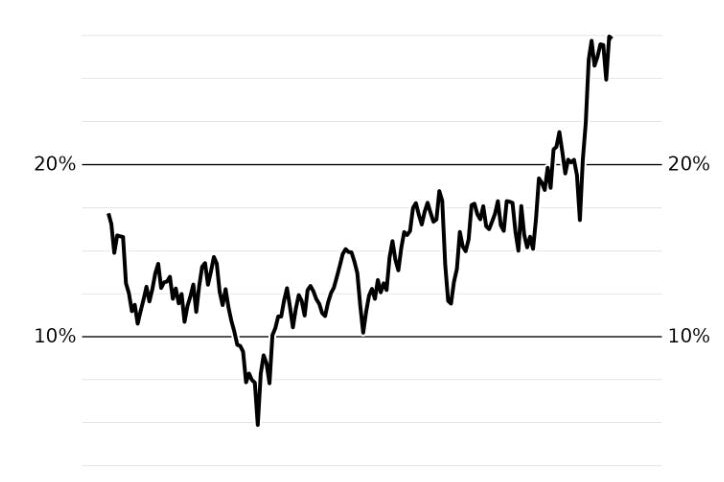
Canadian businesses are immensely profitable, but businesses simply haven't been reinvesting in them. As Tom Goldsmith writes in Orbit Policy's Deep Dives, the financialization of Canada’s economy and the high levels of rent extraction that accompany it are barriers to innovation. We are impoverishing ourselves over the long term to support short-term financial gains. If we care about innovation and productivity, then we need to focus far more critical attention on corporate Canada.

Mark Carney passed a tough test in Washington. He now faces an even tougher one at home | Toronto Star
We predicted that American investors would be looking to buy up Canadian businesses and assets, and that this would threaten our national security and economic sovereignty. Now Canada has to make a call on whether to kill Texas-based energy giant Sunoco's takeover of Parkland Corporation. In the Toronto Star, SCP CEO Matthew Mendelsohn and Chair Jon Shell ask: do we want to be owned by American billionaires, to work for them and have our wealth stripped away to pad bank accounts in New York and Dallas? If we really want Canada to remain ours, they argue, then we need to think and act like it.

Canada’s Liberal party will face down Trump. But will it address inequality? | Truthout
Prime Minister Mark Carney has a monumental task to lead Canadians through the turmoil of a second Donald Trump term, while also addressing various crises: affordability, housing, toxic drugs and health care, to name a few. For Truthout, Nora Loreto interviewed SCP Fellow Silas Xuereb about the crises that loomed over Canada's recent federal election and one fundamental cause that was never clearly identified: concentrated corporate power.

School meals aren’t just good for kids: they can also be good for industry
Scaling up access to school meals through Canada's National School Food Policy is a big win for children and families. As SCP Fellow Sarah Doyle and SCP Advisor Alex Himelfarb outline, the program could also be a win for agrifood businesses, the climate and workers, contributing to a more resilient, just, sustainable and less dependent Canadian economy. The key is an ambitious and strategic approach to food procurement—one that shifts the focus from minimizing price to maximizing public value.

Watch the video: Unleashing Canada’s potential in turbulent times | Canada Growth Summit 2025
The United States’ unprecedented economic assault has brought Canada’s many pressing challenges, both internal and geopolitical, into sharp relief. On April 24, SCP CEO Matthew Mendelsohn joined a panel of experts for a discussion on accelerating investment at Growth Summit 2025. This year's PPF event focused on how to urgently unlock Canada’s economic growth potential to safeguard our country’s global competitiveness—and our own standard of living.
Watch the video: Is Canada really poorer than Alabama?
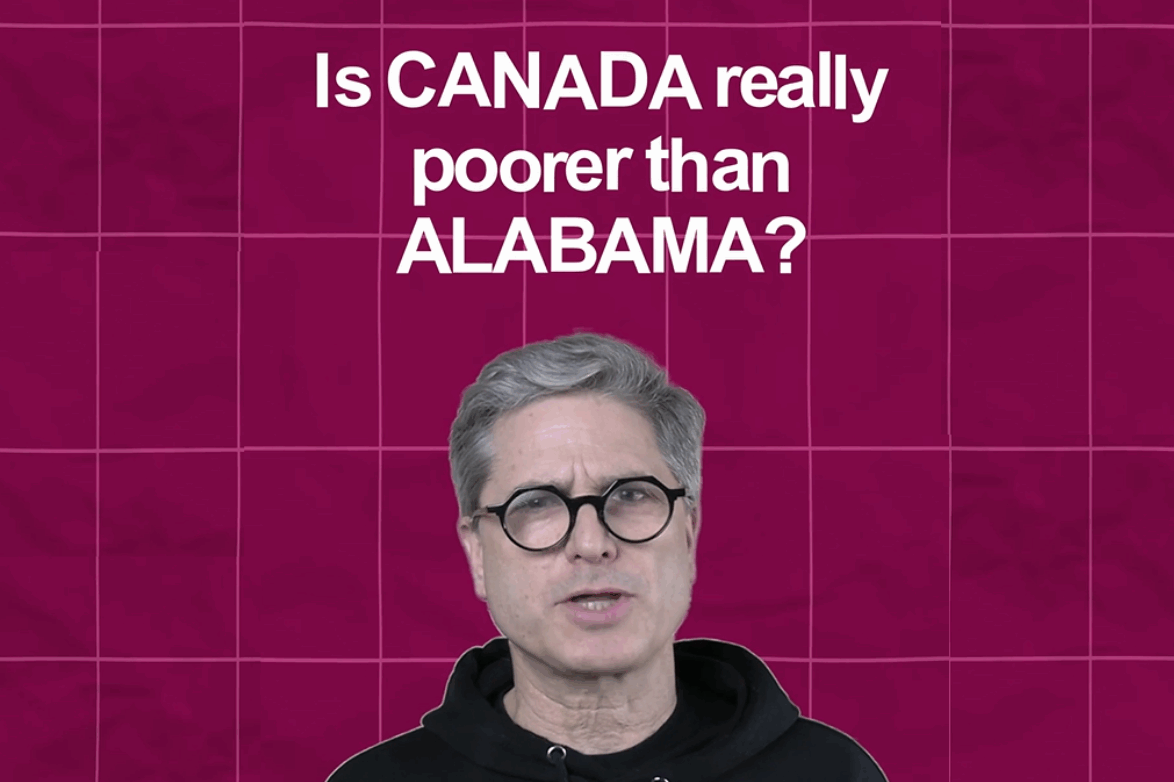
Corporate leaders are obsessing over GDP per capita. But, as SCP CEO Matthew Mendelsohn explains, if you look at just about any number that would meaningfully tell you how well our economy is doing, Canada does better than the U.S. So, when people speak glowingly of the American economic model, and how great it would be if Canada could be more like the U.S., it is worth asking: which aspect of that mess do they really want to replicate here? And how would that be good for Canadians?
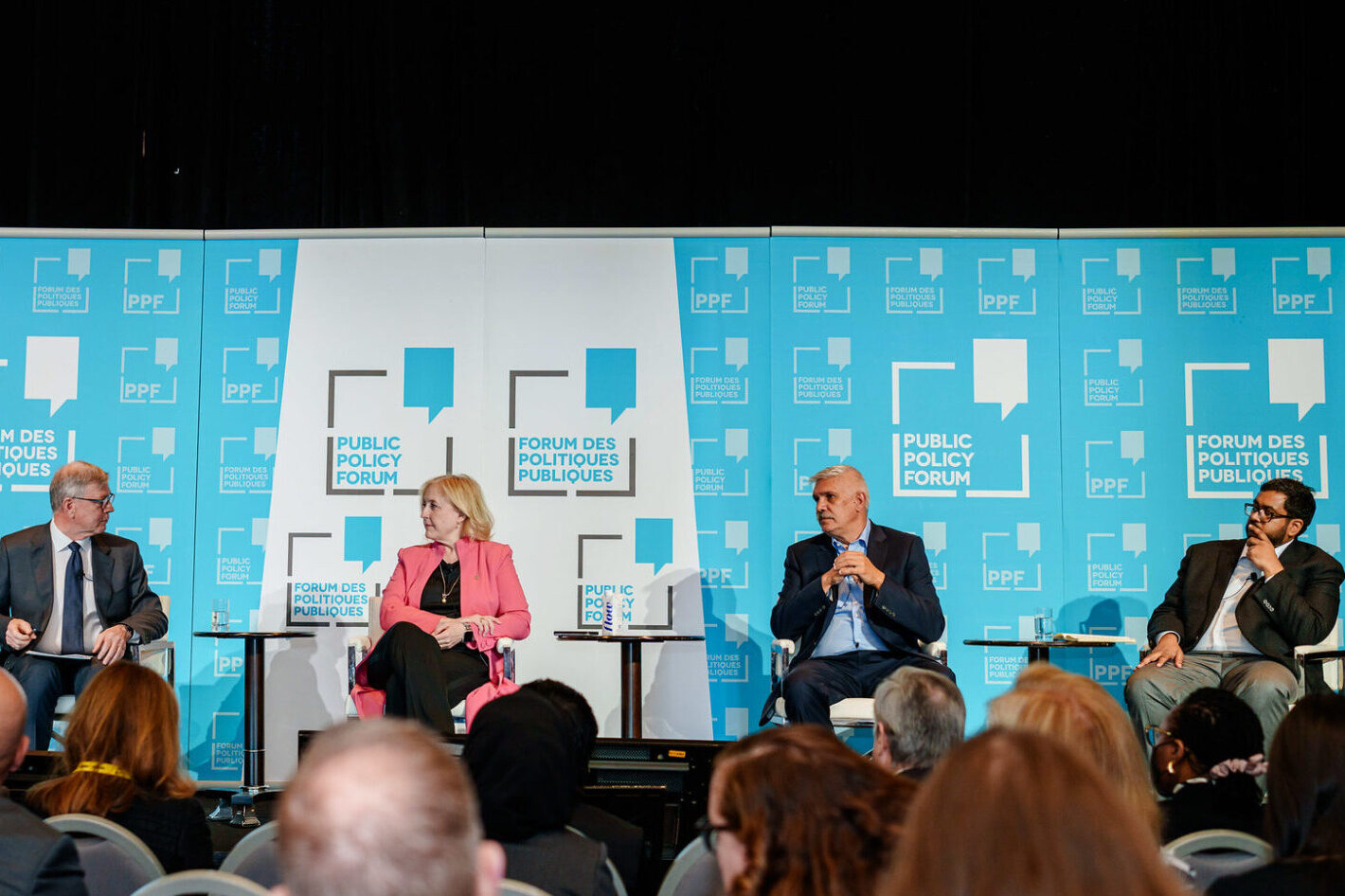
Ten ways to unleash Canada’s potential | Public Policy Forum
As Trump’s mercurial tariff mandate unleashes market mayhem and geopolitical unease, Canadians have galvanized—buying local, putting the maple leaf on everything, ratcheting our elbows way up. Over the course of a dozen sessions at Public Policy Forum’s 2025 Canada Growth Summit, more than 40 speakers, including SCP's CEO Matthew Mendelsohn, put forward a series of smart, actionable ideas for how governments, businesses, policymakers and communities can work together to advance our collective fortunes.

Workforce shocks are coming. Are we going to retreat—or reinvent?
Many Canadian businesses and workers are facing looming furloughs and layoffs. As CEO of Challenge Factory Lisa Taylor argues, these workforce disruptions should be seen as an opportunity to invest in our workers, in our businesses and industries and in the future we want for our families and communities. We must evolve government programs to incentivize businesses to train and upskill workers to meet new market demands and execute on new strategies, rather than lay those employees off. Recovery from workforce shocks is possible with creative ways to reinvent and transform.

Hands Off: Investing in employee ownership can ensure Canadian businesses stay Canadian | ImpactAlpha
While Canada’s policymakers try to figure out how to make the Canadian economy less vulnerable to Trump’s whims, many Canadian businesses are going to look like a good deal for American investors. A weak Canadian dollar, low interest rates and expected liquidity challenges create the conditions for an acceleration of private equity-led buyouts of Canadian firms. In ImpactAlpha, SCP's CEO Matthew Mendelsohn explains how, as Canada faces Trump’s mercurial and predatory approach to trade and economic policy, employee ownership can offer much-needed stability and resilience.
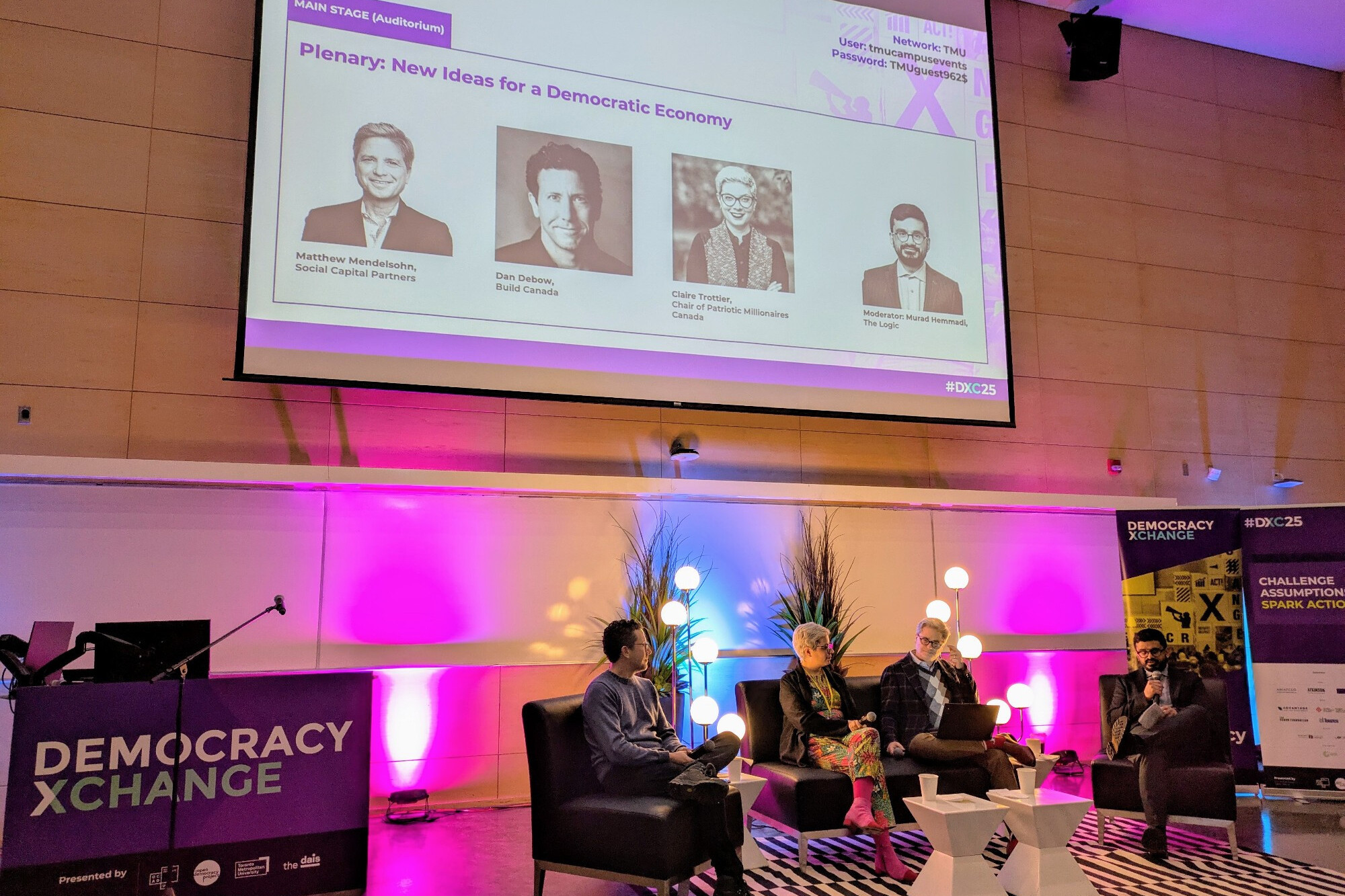
Watch the video: New ideas for a democratic economy | DemocracyXChange 2025
What kind of economy do we want for Canada—one that prioritizes growth and productivity, at any cost? Or one that focuses on greater shared prosperity? Watch the April 5th recording of SCP CEO Matthew Mendelsohn and an expert panel discussing "New Ideas for a Democratic Economy" at DemocracyXchange 2025.
Are young people giving up on Canada? | Missing Middle Podcast
Sabrina Maddeaux and Michael Moffatt explore how the inability to afford housing not only affects individuals but also poses systemic risks to the Canadian economy and society. They delve into the implications of economic vulnerability, the talent exodus to the U.S. and the growing disconnection among younger generations, emphasizing the urgent need for a cohesive housing policy that addresses these interconnected issues to ensure a stable and resilient future for Canada.

As Canada prepares for disruption and sacrifice, whose side are our leaders on?
In this election, Canadians are looking for a leader who will stand up to economic threats from our mercurial and adversarial neighbour. But how, Matthew Mendelsohn asks, will the ideas on offer help workers, regular people, not-for-profits and smaller and medium-sized businesses transition to the emerging new world order? Yes, Canada needs economic growth, but it needs to be the kind that enriches working Canadians, not just not just large financial and corporate interests.

A ‘silver tsunami’ of business exits is coming—here’s how to keep them Canadian
A combination of rising U.S. tariffs, a weakening Canadian dollar and a generation of business owners nearing retirement has created the perfect storm for a wave of foreign takeovers. SCP's Michelle Arnold, Futurpreneur's Karen Greve Young and Venture for Canada's Scott Stirrett on how a few targeted policy changes could enable aspiring entrepreneurs to buy existing businesses, keeping jobs and ownership local while injecting fresh energy into our Canadian economy.

Policy ideas that meet this moment can come from anywhere—even LinkedIn
From fighter jets to TikTok, nothing is off the table when Canadians talk about how best to counter Trump's economic assault on Canada. SCP brings you some creative, crowdsourced policy ideas gathered by our Chair Jon Shell on a recent LinkedIn post. More evidence that new voices entering the policy discussion will help us get through the current crisis and emerge in a more hopeful place.

How employee ownership can help secure Canadian sovereignty | The Calgary Herald
With Canada’s sovereignty at stake, we must invest in every approach to keeping Canadian businesses in Canadian hands. If we match the U.K.'s success in incentivizing employee-ownership conversion, we would see 300 Canadian companies sold to their workers each year. SCP Chair Jon Shell and Employee Ownership Canada CEO Michael Ras explain how very few policies promise as powerful an outcome.

The hidden takeover of our economy—and 5 things we can do about it
Today, Canada’s main streets are more likely to feature American chains and less likely to be locally owned. We already face economic assault from the south—SCP's CEO Matthew Mendelsohn and Fellow Rachel Wasserman on why we cannot accept unchecked serial acquisitions as a tactic in this economic war against us and what we can do about it.

Four ways to keep Canadian businesses in Canadian hands
Despite the fact that governments, business leaders, workers and Canadians all say they want to be less economically vulnerable, there is a real risk that, two years from now, even more of our businesses and assets will be owned by U.S. investors. SCP's CEO Matthew Mendelsohn and Chair Jon Shell propose four ideas to prevent American finance from gobbling up the Canadian economy.

Canada is a way better bet than the United States right now
Canada’s value proposition aligns with the values most Canadians hold, even if we execute on them imperfectly: diversity, inclusion, freedom, equality, democracy, respect and reconciliation. SCP's CEO, Matthew Mendelsohn, on why he would rather invest in a country that strives to uphold those values and build an inclusive, democratic capitalist system than invest in the uncertain, volatile mess that is the United States right now.

The strength within: Some economists say we can’t count on fair and open trade with the U.S. anymore. Is it time for Canada to look inward instead? | Toronto Star
When U.S. President Donald Trump threatened to launch a full-blown trade war with its closest ally, many Canadians felt as if their best friend had suddenly turned around and stabbed them in the back. The Star spoke with economists, academics and other experts, including SCP CEO Matthew Mendelsohn, about how the country should best navigate this new era of Trump's isolationism, and found there are realistic steps we can take to reduce our dependence on the States.

Three ideas to make home ownership more affordable that aren’t getting the attention they need
Canadians are more vulnerable to Trump’s economic warfare today because our housing system is in crisis and has left many Canadians without affordable places to live. Some of our own bad policy choices have put us in this position of vulnerability. We've got three housing policy ideas we want the team at Missing Middle to look into.

Concepts of a plan to confront the new United States
Living next to a superpower run by oligarchs is not where we expected to be 20 years ago, says Matthew Mendelsohn. But it’s where we are. Pretending otherwise doesn’t serve our interests. Canada is big enough, powerful enough, smart enough and rich enough to build a stronger, more independent economy if we start now.
The Alternative Exit podcast: Championing Employee Ownership Trusts to revolutionize wealth distribution
SCP Chair Jon Shell sits down with Andy Farquharson on The Alternative Exit Podcast to explore the transformative potential of employee ownership. Jon recounts how he advocated for Employee Ownership Trusts (EOTs) in Canada to address wealth inequality and business succession. He talks advantages of EOTs, from preserving a company’s legacy to fostering economic resilience in the workforce and reshaping both business culture and wealth distribution.
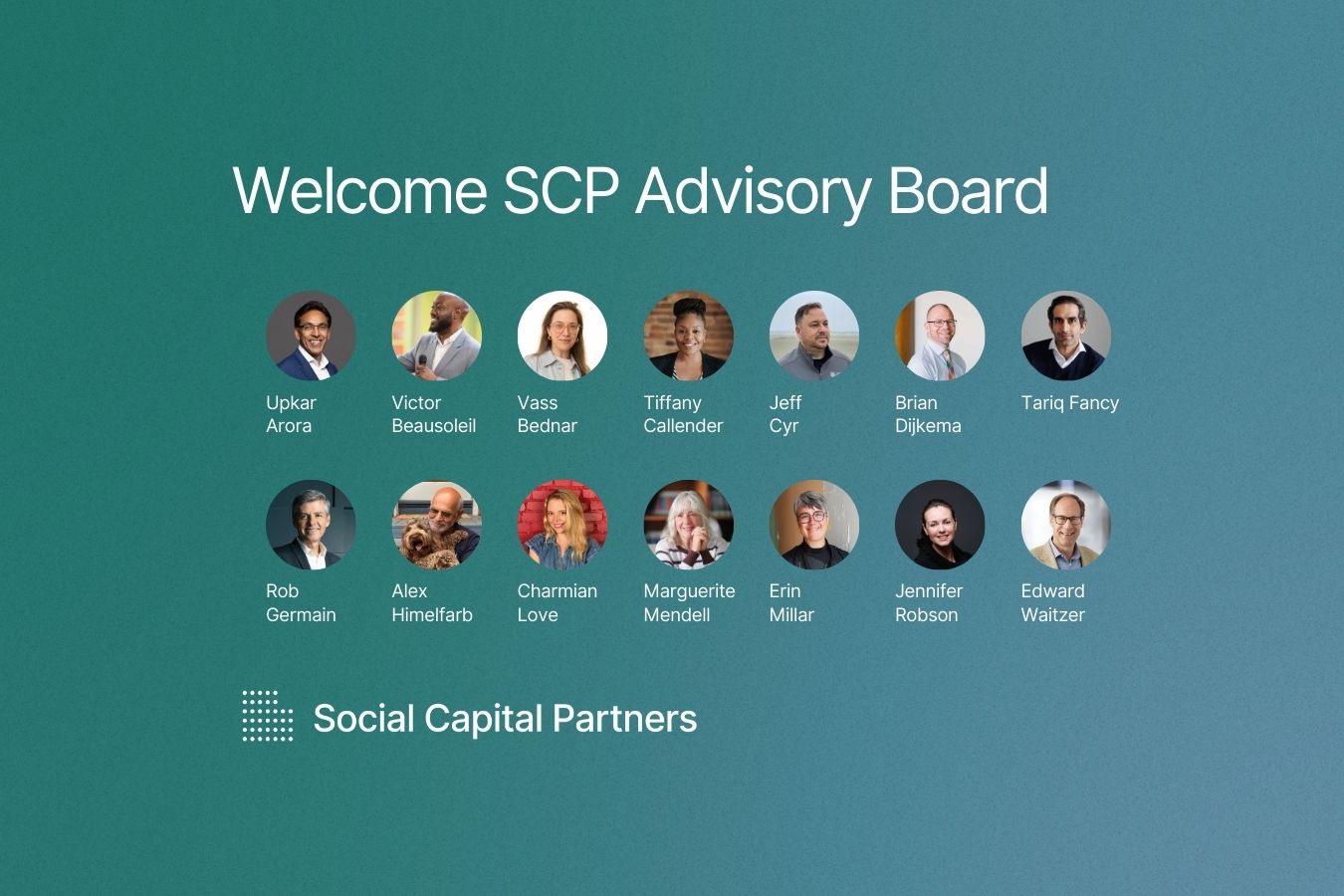
Social Capital Partners appoints slate of new advisors
Advisory Board members will advise on SCP’s strategy and agenda, drawing on decades of experience across finance, business, government, public policy, communications, civil society and community economic development.

A message from Social Capital Partners: We’re going to tell you the truth
There are lots of real, tangible public-policy solutions to the problems we face, says Matthew Mendelsohn. It begins with talking about the economy in a different way, grounded firmly in the public interest and data that reflect the reality of how people experience their economic lives.

Overheard at Crowe Soberman: The EOT advantage
Crowe Soberman Audit and Advisory Partner Chandor Gauthier sits down with Jon Shell, Chair of Social Capital Partners and Board Member at Employee Ownership Canada. They dive into the benefits of Employee Ownership Trusts and get into the nitty gritty of how EOTs can support smooth business succession, boost equity and retention and safeguard business legacies.

At the corner of Main Street and Purpose: Rethinking small businesses by rethinking who owns them
Is alternative ownership the future of business in Canada? Shane Gibson from Future of Good reports on how converting to a non-profit, establishing an Employee Ownership Trust, or becoming a co-operative can help a small business become more sustainable, ensure job security and retain wealth within the community.
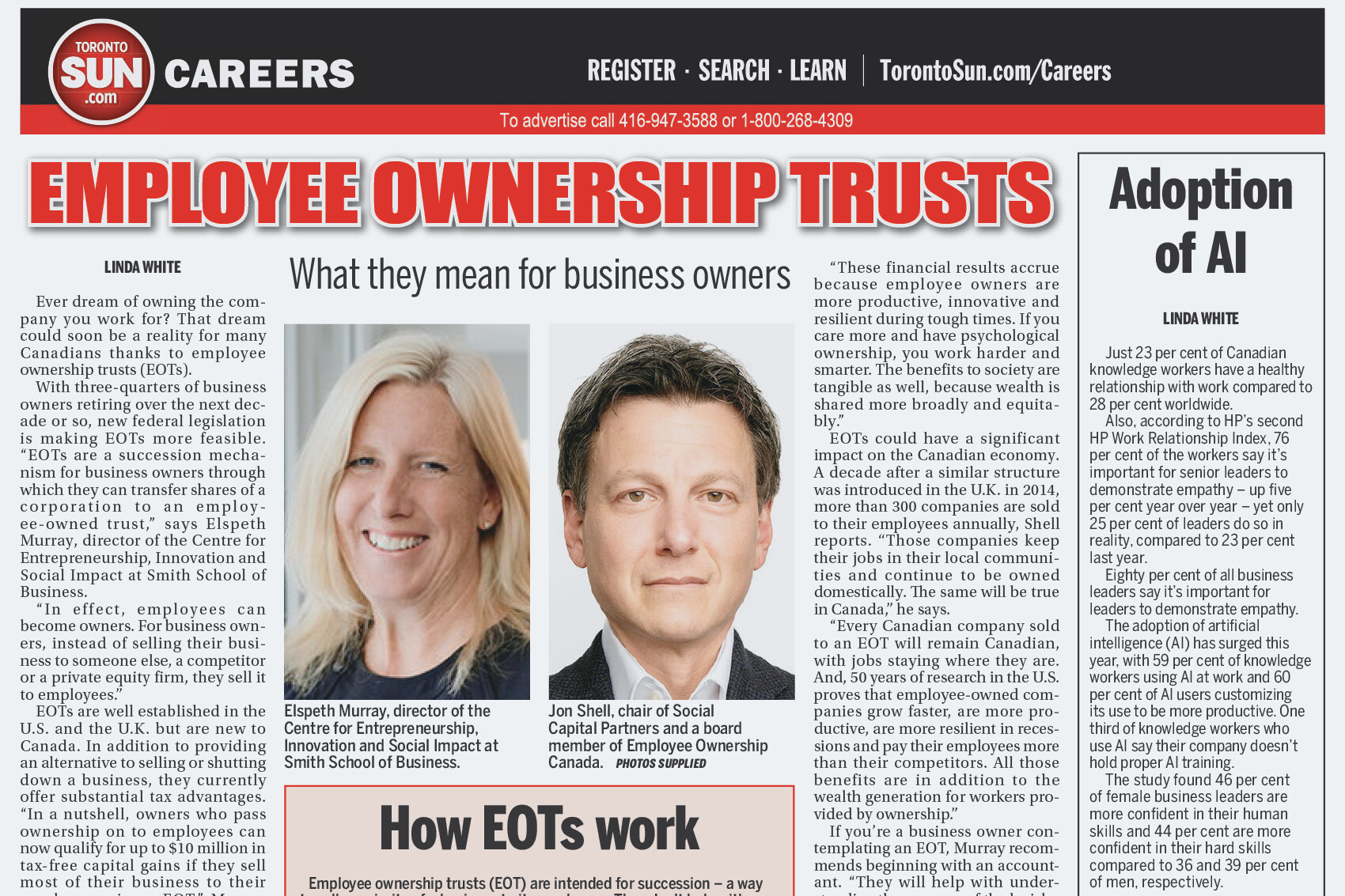
Employee ownership trusts explainer | Toronto Sun
SCP Chair Jon Shell in the Toronto Sun on what Employee Ownership Trusts mean for business owners, the community and the broader economy
Uncommons Podcast: Wealth inequality and inclusive growth with Matthew Mendelsohn
Social Capital Partners’ CEO, Matthew Mendelsohn, joins Member of Parliament for Beaches-East York, Nate Erksin-Smith, on his podcase “Uncommons”. Matthew and Nate talk about wealth concentration and its threat to democratic stability. They also discuss practical solutions to address wealth inequality, lack of trust in democratic institutions, the role of the federal public service and the need for a competent and responsive government.

Employee Ownership Trusts make it easier for Canadian businesses to share wealth with employees
When outside interests take over a small or medium business, it's often purchased then closed, leaving holes in the community. Future of Good reports on how new laws could encourage more retiring business owners to sell to their employees through Employee Ownership Trusts. EOTs help businesses stay local and contribute to employee retention and financial wealth.

Mark Carney and the Canadian business elite need to think more about growing wealth inequality that is destabilizing democracies around the world
Mark Carney made a speech last week and many people had plenty to say about it. But one of his replies during the Q & A deserves more attention than it received. MP Nate Erskine-Smith asked Carney what he would do about Canada’s growing wealth inequality. Carney’s answer was a bit unfocused, but he made two points clearly: 1) Let’s hope wealthy people give more to charity, and 2) We shouldn’t only focus on redistribution.

Employee ownership trusts: What they mean for Canadian business owners
A helpful summary of Employee Ownership Trusts that gives Canadian business owners and their advisors a simple (albeit not short) explanation about what they are, and why they should care.

Employee ownership trusts FAQs
Bringing EOTs to Canada has been a labour of love for a lot of people over the last few years. We’re deeply grateful to the government for establishing the policies we need for employee ownership to flourish here. Now that it’s real we can’t wait to see the community pick the idea up and run with it.

Budget 2024 unleashes unprecedented opportunities for employee ownership in Canada
After four years of research, engagement and advocacy, the federal government has finalized the legislative and tax structure for Employee Ownership Trusts (EOTs). Social Capital Partners and the Canadian Employee Ownership Coalition are grateful for the government's careful work to make EOTs an attractive option for business owners.
Billionaire Blindspot: How official data understates the severity of Canadian wealth inequality
Statistics Canada's official wealth survey significantly underestimates wealth inequality. Canada’s wealth concentration is not as extreme as in the United States, but closer than official data suggest. This misleading portrait undermines Canadians’ ability to have an evidence-informed conversation about how to address growing wealth concentration and the threats it represents for economic resilience and democratic stability.
Preparing for SCP’s next strategic phase
Social Capital Partners has a long history of investing in people and projects that create more economic opportunity in Canada. Recently, our focus has been on establishing more avenues for working Canadians to build wealth through ownership. Learn more about what we are moving towards.

Unlocking the potential of employee ownership in Canada
In the US and the UK, employee-owned companies grow faster, pay better, are less prone to lay-offs or bankruptcies in economic downturns, and are more likely to keep jobs in local economies. Due to supportive public policy, EOTs are a popular structure for business succession in those countries and have generated significant wealth for front-line employees. Canada does not have a business structure comparable to the employee ownership trust (EOT).

Canada is bad at studying wealth inequality and we explain why that matters
Social Capital Partner's Director of Policy Dan Skilleter summarizes the key findings of his recent report "Billionaire Blindspot" in a Toronto Star Opinion piece.

Social Capital Partners releases new report on wealth inequality in Canada – concludes that official statistics significantly underestimate the problem
This new report critically analyzes Canada’s flagship wealth survey, the Survey of Financial Security (SFS), and outlines how its methodological shortcomings lead to significant underreporting of wealth inequality.
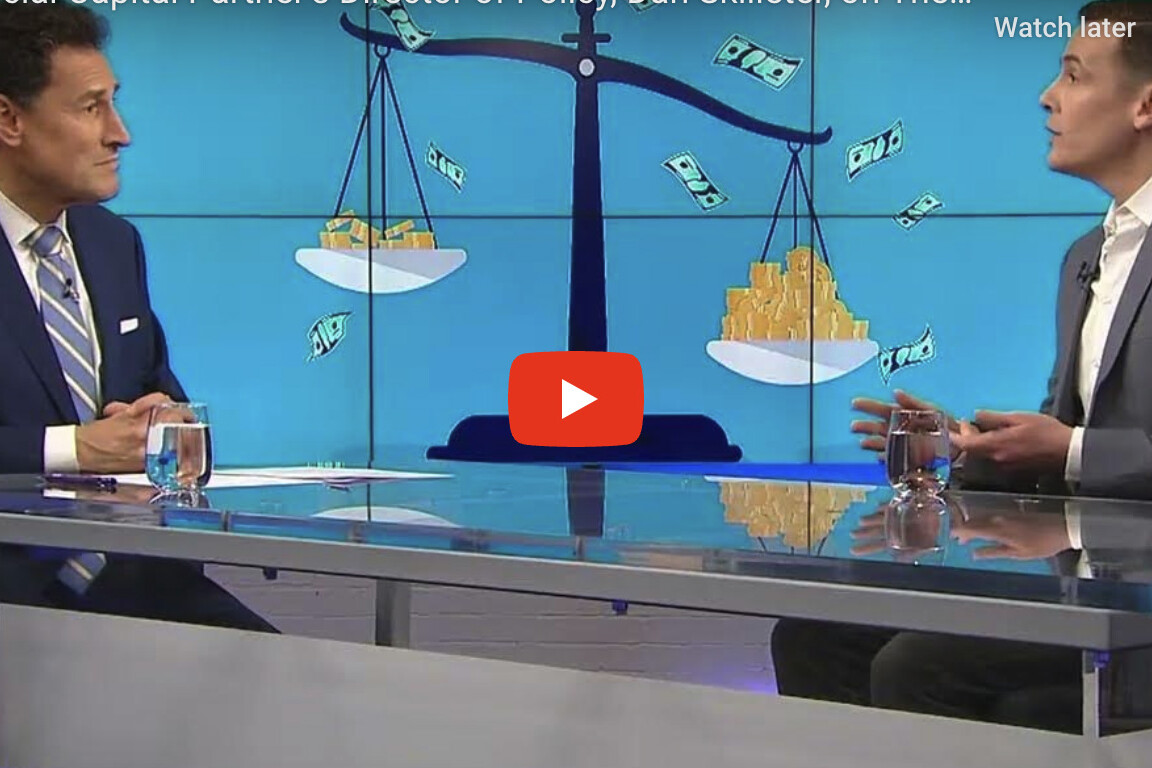
Social Capital Partner’s Director of Policy, Dan Skilleter, on The Agenda with Steve Paikin
Social Capital Partner’s Director of Policy, Dan Skilleter, sits down with Steve Paikin on The Agenda to discuss his recent report “Billionaire Blindspot”. This segment digs into how Canada’s official statistics severely underestimate how rich the richest Canadians are and includes steps that can be taken to correct this misrepresentation.

Bank of Canada’s unproductive productivity speech
Social Capital Partners' CEO, Matthew Mendelsohn, reflects on the Bank of Canada's productivity speech and calls for need of fresh ideas, voices and questions.

Inclusive search fund concept paper
Search funds allow entrepreneurs without capital to buy small businesses. However, only an exclusive club can access the financing to do so and are often forced to re-sell their businesses. We’ve put a twist on the search-fund model to make it more inclusive and long-term.
Building an employee ownership economy
New research continues to demonstrate that employee ownership fosters economic resilience. As in previous economic crises, employee-owned companies were better at retaining employees and at maintaining hours and salaries throughout the pandemic. In a post-pandemic economic environment, the demonstrated benefits of increased employee retention and alignment by employee-owned companies will be even more important to support economic growth.

Taylor Guitars’ transitions to 100% employee ownership with support from the Healthcare of Ontario Pension Plan (HOOPP) and Social Capital Partners (SCP)
In a transaction that would be impossible for a Canadian company, the owners of North America's largest builder of acoustic guitars secure a sustainable future for their company and its employees.

Business-in-a-box concept paper
Small, independent businesses are the backbone of our economy. Unfortunately, they’ve become harder to start and struggle to compete with large chains. We’ve been inspired by owner-owned cooperatives that help small businesses thrive.
Rate drop rebate: final evaluation report
The story of the Rate Drop Rebate pilot, including key milestones, successes, dilemmas, insights and lessons learned. The Rate Drop Rebate was a unique partnership that brought SCP together with financial institutions, publicly funded employment service providers and the Government to reduce unfair barriers to employment and help grow the province’s small and mid-sized businesses.

Ontario launches rate drop rebate in London
Ontario is launching an innovative partnership with financial institutions to help businesses in London grow and increase employment opportunities for people with disabilities and facing other barriers. Through the new Rate Drop Rebate program, small- and medium-sized businesses that hire eligible people can receive discounted rates on financial products, such as loans. The rebate is made possible through funding from Ontario's two-year, $4-million Community Loans Fund.

Ontario financial institutions and government join forces to boost local businesses and do good in communities
Rate Drop Rebate™ pilot is expected to significantly impact those facing barriers to employment include students with limited work experience, long-term unemployed, older unemployed, people with disabilities, newcomers to Canada and unemployed Indigenous persons. The program aims to generate up to 1,100 new employment opportunities.

Ontario improving employment opportunities for people facing barriers
Ontario is partnering with leading financial institutions to build on Social Capital Partners existing loan program and create a fund aimed at increasing employment opportunities for people facing employment barriers.

Partnership council on employment oportunities for people with disabilities
The Partnership Council champions the hiring of people with disabilities and provides strategic advice to the Ontario Minister of Economic Development, Employment and Infrastructure to enhance employment opportunities for Ontarians with disabilities.

Social Capital Partners and Ontario Government to begin consultations with Canadian financial institutions for a Community Loan Pilot Project
Social Capital Partners announces innovative collaboration with the Government of Ontario designed to explore a novel social finance approach that provides employment opportunities for people with disabilities and other vulnerable populations.

Social Capital Partners’ collaboration with the Ontario Ministry of Economic Development, Trade and Employment
Social Capital Partners collaborates with Ontario government’s Office of Social Enterprise to explore a pay-for-performance model that will increase access to employment opportunities for persons with disabilities, new Canadians and other traditionally disadvantaged groups.
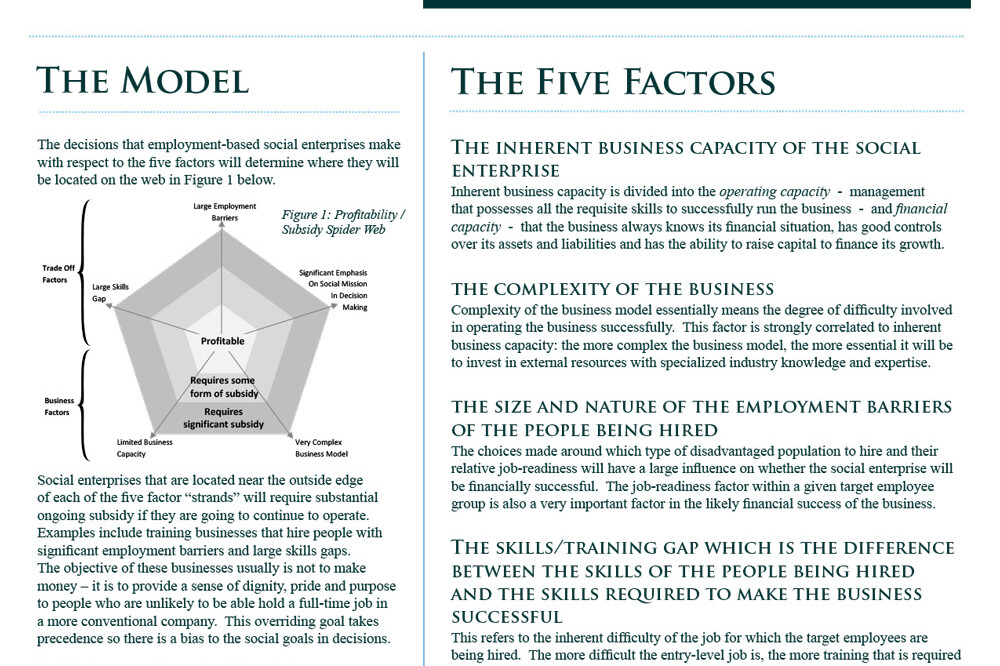
The five critical factors of social enterprise profitability
What are boards, investors and management teams to do when there is tension between the financial and social bottom lines of social enterprises? Social Capital Partners shares learnings gleaned from seven years of investing in employment-based social enterprises. We identify the five most important factors that determine whether a social enterprise will be profitable or require some form of subsidy.
Working together: Implementing a demand-led employment and training system
Canada’s approach to training and development needs reform. Billions of dollars are spent annually on job training and skills development, with limited evidence of lasting benefits. Most problematic, employers’ talent needs (i.e., actual skills demand) are not formally embedded in the process of determining how or where money is spent, leaving a fundamental disconnect between demand for skills and the investments being made by governments.

A Fine Balance: What Inner City Renovations taught us about managing social and economic objectives inside business models
What are reasonable profitability targets for a social enterprise start-up with a mission to create employment for disadvantaged populations? How does external financing play a role in the execution of the social mission and how does a social mission as a key part of the business model impact the ability to reach profitability targets? SCP showcases one of our early investments and highlights key learnings about the inherent mission tensions in these business models.
Social return on investment report: TurnAround Couriers
SCP reports on six years of TurnAround Couriers, a social-purpose business dedicated to helping at-risk youth in the Greater Toronto Area overcome social and economic obstacles by providing them with a chance to get ahead.